As a chemical producer with decades of hands-on work in organic synthesis, I’ve watched 2-Hydroxyvalerate progress from an obscure laboratory curiosity to a substance with rising relevance in both research and industrial practice. In the earlier decades, most mention of 2-Hydroxyvaleric acid hovered around rare metabolic disorders and specialist biochemistry projects. It gained a more significant footprint with the boom in chiral chemistry and specialty polymers—fields where small tweaks at the molecular level meant big leaps for function and performance. The substance drew new scrutiny as the polymer world searched out sustainable building blocks and biodegradable pathways, turning a previously overlooked carboxylic acid into a candidate for future materials. This shift didn’t arrive through abstract theorizing. Real challenges—environmental demands, cost pressure, and improved process control—drove a new wave of application and manufacturing effort, much of it pushed by chemical producers willing to engage in serious hazard analysis, process design, and end-use consultation.
In practical terms, 2-Hydroxyvalerate shows up as an off-white crystalline solid or a clear, viscous liquid, depending on purity and storage. Its main calling card is a carboxylic group nested three carbons away from a secondary alcohol. That structure opens up direct routes for esterification, amidation, and other classic chemical modifications. End users chase it for these transformation pathways rather than for direct use. We rarely get requests for the acid itself as a consumer commodity; rather, formulators need precise batches tailored for use in multi-step syntheses, diagnostic reagents, or unique polymer intermediates.
Anyone producing or applying 2-Hydroxyvalerate deals with its modest melting point and moderate water solubility. It flows well in common polar solvents, but not in nonpolar ones, creating some challenges when building new downstream chemistry around it. In a practical sense, the molecule’s secondary hydroxyl confers certain advantages in both reactivity and selectivity—advantages that organic chemists and process engineers value. We’ve logged observations on its stability profile: the molecule holds up under mild heating and neutral conditions, but aggressive dehydration, strong acids, or oxidizing systems can prompt rearrangement, decarboxylation, or uncontrolled polymerization. The carboxyl group can throw off pungent, sour vapors if left open to the air under low pH, and storage in sealed, dry packages is wise for stability. Our plant operators know that even minor contamination with iron, copper, or high pH washes pushes the molecule to brown, highlighting its sensitivity and the need for precise handling.
Consistent quality rests on setting clear technical specs. For our own production, we track main content by HPLC, target moisture below 0.3%, and keep residual solvent levels from distillation at single-digit ppm. Each lot is traced for trace metals, color, and organic byproducts. Labels inform explicitly: systematic names such as 2-Hydroxyvaleric acid, European EC registry number, and batch-specific assay details. Transparency supports user safety and proper compliance, especially since shelf-stable organics like this sometimes get mixed up with similar-sounding acids or derivatives. In my experience, excessive ambiguity on a label only invites costly mistakes in the field.
Traditionally, 2-Hydroxyvalerate comes from chemical synthesis starting with valeric acid or its derivatives, followed by controlled hydroxylation. In our operation, we focus on catalytic hydroxy-functionalization of pentanoic acid or reductive methods using α-keto precursors. The biotechnological route via fermentation or enzyme catalysis now pulls significant attention thanks to a push for lower-carbon-footprint manufacturing. Our chemists closely monitor pH, temperature, and feedstock impurity load; the entire process demands real vigilance from raw material qualification through final filtration and crystallization. Waste minimization and solvent recapture run in parallel with the batch, as large-scale producers always have one eye on costs and another on environmental compliance. These lessons only become real after feet-on-the-floor experience with the quirks and pitfalls of scaled chemistry—no flowchart ever matches the feedback from an experienced plant crew.
Chemically, 2-Hydroxyvalerate gives chemists a toolbox of options. Its secondary alcohol group invites oxidation to a corresponding ketone or can form bulky esters with acylating agents. The acid end opens up amide and ester syntheses, making it useful for polymer preps and for specialty surfactant development. Under basic or enzymatic conditions, ring-opening and homologation come into play, which has real traction in specialty materials and biomedical probe synthesis. In industry, modification pathways get chosen for their ability to limit side reactions, maintain chirality, and simplify downstream purification. The real work comes in balancing cost, process time, and waste management. Years of practical synthesis reveal certain routes as much cleaner and more robust, a lesson that only emerges when one reviews process yields over hundreds of batches, not simply from the published literature.
End users will see this chemical sold as 2-Hydroxyvaleric acid, DL-2-hydroxyvalerate, or 2-Hydroxypentanoic acid, among others. Each synonym reflects different naming conventions favored by various regulatory agencies, catalog suppliers, or research publications. Internally, consistency carries more weight; we rely on accurate naming throughout material flow to avoid batch mix-ups or miscommunication between departments and customers. Skipping over consistent nomenclature in favor of trend-driven branding often leads to regulatory headaches or improper use—an avoidable risk in any responsible production environment.
Safety in handling 2-Hydroxyvalerate draws on its moderate acidity and the potential for mild skin or respiratory irritation at higher concentrations. Our plant requires gloves, goggles, and local exhaust ventilation during weighing, mixing, and transfer. Cleanroom-level standards won’t be strictly necessary, but we reinforce good chemical hygiene through regular training and incident recordkeeping. Spill kits stay on hand for accidental releases, and our waste disposal protocols meet or exceed regional environmental benchmarks. Regular audits of equipment integrity, containment, and documentation prevent small problems from growing into compliance failures. These routines come from years of operating experience and a firm awareness that real-world conditions never conform neatly to theoretical expectations.
Customers request 2-Hydroxyvalerate for projects as varied as biodegradable plastics, research into new metabolic pathways, drug synthesis, and chiral auxiliary exploration. It serves as a starting block for polyesters in the packaging and agricultural sectors, especially for teams looking to swap out petroleum-based elements with more sustainable options. Pharmaceutical and diagnostics researchers appreciate its use in probe molecule construction or as a calibration standard for metabolic assays. As a manufacturer, we field requests from both established firms and academic teams seeking to push boundaries in biocompatible materials or next-generation catalysts. The greatest insights often come through direct, long-term partnerships with labs determined to understand and exploit this molecule's properties beyond simple catalog applications.
Active R&D in our facility extends beyond optimizing yields. We invest in developing greener synthetic routes, scaling up biotechnology-based preparation, and tightening controls on stereoselectivity. Much of our collaboration involves external experts in enzyme engineering or process scalability. We also sample new downstream uses in medical devices, combinatorial chemistry, and advanced personal care products. Our in-house chemists push continually for new process windows, aiming to drive higher purity, better shelf life, and reduced waste. Partnerships with universities and applied R&D centers feed practical insights back into daily production, accelerating feedback between lab discovery and plant execution. The forward momentum in this space comes not from static methods, but from a relentless push to improve, forced by strict regulatory demand and customer challenge alike.
Toxicology assessments on 2-Hydroxyvalerate point to relatively low acute risk at routine exposure levels, supported by in-house testing and regulatory review. Nevertheless, long-term or high-dose studies remain limited, so prudent ops teams err on the side of caution during processing, storage, and sampling. We’ve participated in both in vitro and in vivo studies to clarify metabolic fate and potential environmental breakdown, contributing data to cooperative industry studies. Until broader toxicological consensus forms, we counsel downstream users to adopt standard acids and organic materials protocols, emphasizing spill cleanup, exposure minimization, and good environmental controls.
The future path for 2-Hydroxyvalerate appears brightest where sustainability and advanced material performance intersect. As pressure mounts for biodegradable, renewable-source polymers, this molecule represents an attractive building block for PHA-type thermoplastics and functional copolymers. Our pipeline for next-generation chemical modifications targets new chiral intermediates and bio-based resin systems with properties unattainable from older inputs. Industry-wide, greater transparency on production methods, traceability, and green chemistry benchmarking will set apart those producers willing to pioneer new standards. The market for 2-Hydroxyvalerate will grow where hands-on experience, process innovation, and thorough safety stewardship drive real customer confidence—qualities built up only through years on the manufacturing floor and direct engagement with science and industry partners.
Years of hands-on experience producing 2-hydroxyvalerate has shown our team how this chemical earns its place in both research labs and industrial operations. The distinctive properties of 2-hydroxyvalerate—also known as 2-hydroxyvaleric acid—draw the interest of chemists and biotechnologists looking to expand the limits of sustainable production and advanced material science.
The fermentation world has seen shifts over the last decade. Many researchers started using 2-hydroxyvalerate as a monomer in the production of biodegradable plastics, especially polyhydroxyalkanoates (PHAs). These are sought after as alternatives to conventional petroleum-based products. Factories that produce PHAs often rely on straightforward feedstocks. Yet, the unique branching and chain length of 2-hydroxyvalerate unlocks improvements in the flexibility and strength of finished bioplastics. Compared to shorter or longer alkyl chain hydroxy acids, this molecule strikes a balance that affects not only the melting points of materials but also their degradation behavior. For manufacturers, this translates into a pathway toward more customizable and application-focused bioplastics—without expensive modifications down the line.
We receive inquiries from institutes studying inherited metabolic disorders. 2-hydroxyvalerate levels in human samples can act as a biomarker for certain metabolic dysfunctions. Technicians need a reliable, pure standard to detect those subtle, clinically significant changes. High-quality manufacturing supports accurate results, which carries real consequences for patient care and ongoing research. Inconsistent material purity throws doubt into diagnostic conclusions, so tightly controlled synthesis and testing form the backbone of trust between us and these labs.
Chemists working in pharmaceuticals depend on chiral building blocks like 2-hydroxyvalerate. It serves as a precursor or intermediate in synthesizing molecules that exhibit specific, valuable chirality. We have seen demand rise as more companies pursue drug candidates with precise three-dimensional structures. Purity and batch-to-batch reproducibility avoid unnecessary troubleshooting down the process chain. Insights from scale-up projects made clear: if quality slips, so does the reliability of downstream reactions. Investing in pure, well-documented material saves time for chemists and smooths the way for innovation.
Across our operations, controlling byproducts remains a challenge. This molecule carries a functional group configuration that can easily encourage side reactions if process conditions drift. Tight process monitoring and robust analytical tools catch impurities before they reach the client. Feedback from our regular clients—ranging from research groups to multinational biotech firms—drives our commitment to continuous process improvement. Removing excess water and limiting thermal exposure during purification improves both shelf stability and downstream performance. Our teams regularly revisit protocols, reflecting the learning that comes from real-world use.
2-Hydroxyvalerate’s versatility earned it a place on the bench and in the reactor. Supporting next-generation polymers, enabling metabolic research, and unlocking more efficient synthetic routes, it remains a steadfast choice for those seeking reliability and performance. We see growth where practical outcomes matter—performance-driven projects and forward-looking chemistry. Meeting those needs starts long before delivery, in careful process design and ongoing evaluation.
Every day we work with a dozen carboxylic acids that look similar on paper, but 2-hydroxyvalerate stands out once you get to know it. As a manufacturer who’s handled this molecule from the reactor all the way to the bottle, I see its quirks and its value play out in the plant and in the hands of end-users alike.
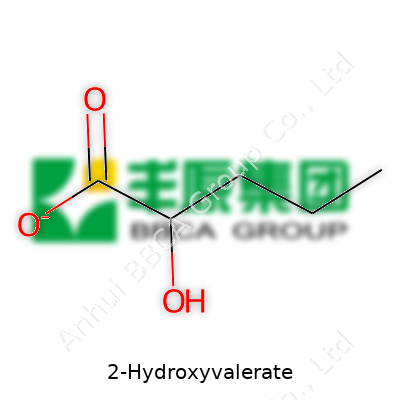
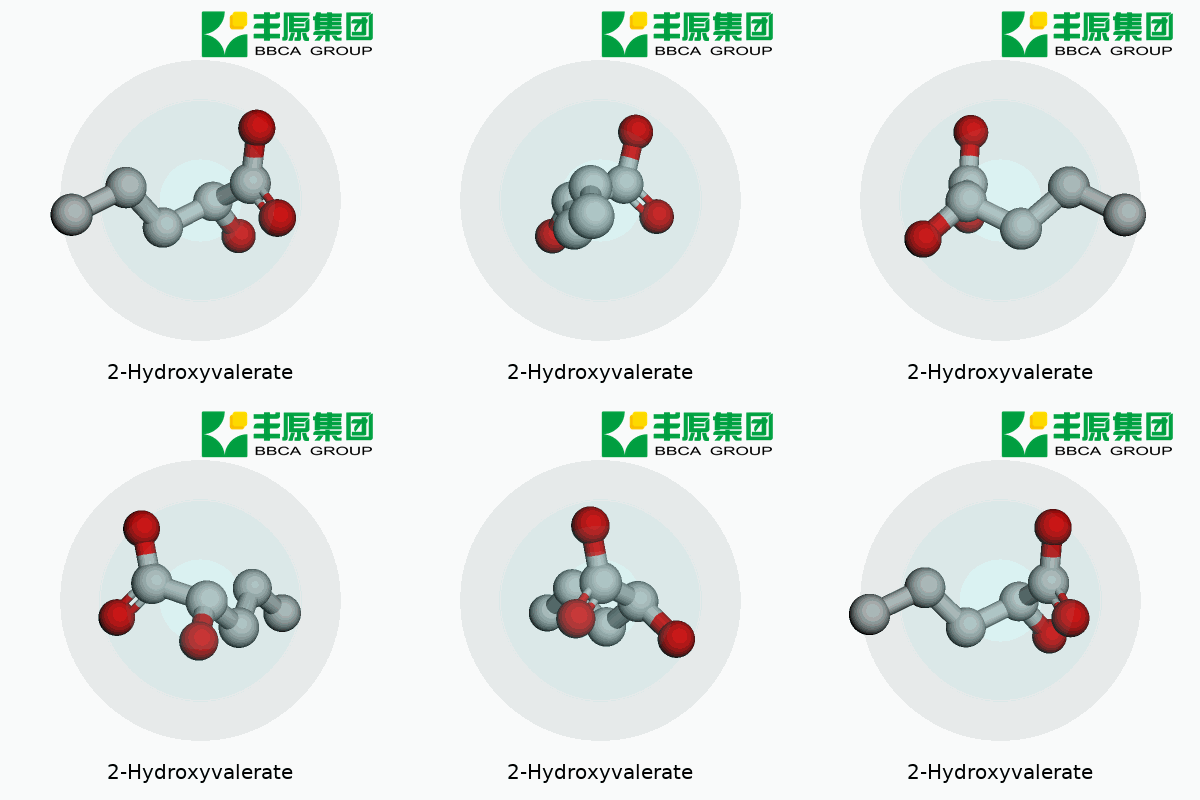
At its core, 2-hydroxyvalerate features a five-carbon skeleton with a hydroxyl group on the second carbon and a terminal carboxyl group. Anyone who’s worked with similar hydroxy acids—like lactic or hydroxybutyrate—knows these functional groups open doors to reactivity that pure valeric acid just can’t compete with. That second-carbon hydroxy group changes how it interacts during esterification, amidation, and polymer reactions.
Handling the raw acid, you notice a higher polarity than standard straight-chain acids of this length. The molecule dissolves well in water and many alcohols, owing to its hydrophilic nature and smaller alkyl segment. Its acidity isn’t as sharp as acetic or lactic, but the carboxyl proton still leaves easily in typical conditions. People using it for synthesis appreciate that moderate acidity when they’re designing pH-sensitive reactions.
Heat sensitivity in hydroxy acids can sometimes complicate processing. In the case of 2-hydroxyvalerate, we see good resilience up to moderate reaction conditions (think 140-160 degrees Celsius) before any meaningful decomposition. It won’t last in harsh acid chlorination or strong oxidizers, but it holds up under many reactions common to the plastics or pharmaceutical sectors.
We’ve also watched our partners push it into polyesters through enzymatic and traditional chemical routes. Because that hydroxy group isn’t right on the end, but next to it, polymer properties shift—offering more flexibility and sometimes better degradation in resulting polyesters. Bacteria can eat poly(2-hydroxyvalerate)-based plastics, which gives it interest in green chemistry applications.
Chemists in our R&D labs like it for the variety of building blocks it delivers. The two reactive sites (hydroxyl, carboxyl) give multiple points of entry for new reactions, whether you’re looking to build chiral intermediates or amino acids. The water solubility helps with purification steps, especially compared to longer-chain analogs that require more aggressive solvents.
We have seen some customers struggle with storage—hydroxyvalerate shows a tendency to self-esterify or slowly oxidize if left uncapped in humid conditions. Glass and proper seals fend off these issues in practice, but it highlights the importance of well-planned logistics and packaging. Moisture barriers are essential to keep purity up and waste down.
2-Hydroxyvalerate doesn’t bring the same volatility or acute hazards as shorter hydroxy acids, but it still asks for the usual PPE and ventilation during synthesizing or transfer. No unusual catalytic hazards or byproducts occur in our experience, which gives it a leg up in regulatory compliance planning. Biodegradability ticks another box for those wanting cleaner lifecycle end-points.
Scaling up this organic acid for commercial production takes attention to reaction selectivity, especially in the hydroxy placement. Hydroxy acids often form side products if the pH, temperature, or precursor ratios deviate, and 2-hydroxyvalerate is no exception. Careful distillation cuts the work in downstream purification. Customers wanting optical purity can get it, but it costs more in labor and feedstock prep.
End-users in biomedical, polymer, and flavor industries push us to refine methods, but each group appreciates the same traits: clean handling, definable reactivity, and a balance between hydrophilicity and acid strength. Among carboxylic acids, 2-hydroxyvalerate claims its place in the toolkit for those very reasons—from our bench to your process.
Every day on our production floor, we work with chemicals that reward respect, knowledge, and vigilance. 2-Hydroxyvalerate doesn’t break the mold. Its use spans research, pharmaceutical development, and specialty chemical production. Chemists rely on its traits—a carboxylic acid with a single hydroxy group branching off a five-carbon chain. Even though it isn’t a household name, it’s a staple in our catalog and, by extension, our workplace.
The question, “Is it safe to handle?” crosses the mind of every technician, engineer, and manager. Over years of manufacturing and packaging batches of 2-Hydroxyvalerate, we have witnessed patterns. Good chemistry doesn’t mean safe chemistry. That’s why experience and risk assessment come first.
At room temperature, 2-Hydroxyvalerate looks tame—a crystalline or powdery solid, with little inclination to ignite or fume. That visual calm conceals the realities inside the lab. Most exposure concerns arise from ingestion, skin, or eye contact. High concentrations may cause local irritation, even burns in the worst case. The compound doesn’t give off a strong odor that easily warns of exposure. Over the years, our chemists have seen that splashes and dust can quickly turn a routine batch into a reason to head to the eyewash station.
We have always required gloves, goggles, and lab coats for every employee handling it. Facilities with proper fume extraction grant an extra measure of protection. Safety showers and eyewash stations remain in arm’s reach, not as window dressing, but because split seconds matter if contact occurs. Periodic training refreshers keep the risks on everyone’s radar. Once, a new hire misunderstood the clean-up protocol. Because a team member caught it and corrected them, we avoided a possible skin irritation that could have sidelined them for days.
The globally harmonized system classifies chemicals based on immediate and chronic health effects. 2-Hydroxyvalerate sits in a relatively mild category. It lacks the volatility and reactivity seen with stronger acids. No evidence directly links it to chronic illnesses or carcinogenicity at levels seen in the workplace. We always point workers to official safety data, but these profiles matter most in the context of real daily handling—scooping powders, measuring solids, making solutions.
Safe handling always boils down to preparation and respect for chemistry. Training remains a cornerstone of chemical manufacturing. We educate new staff not just because the law says so, but because every pair of eyes and hands in the facility affects everyone else. We invest in PPE and enforce its use, even during short stacking or labeling operations, because experience has shown that accidents often happen in these brief “in-between” tasks.
Engineering controls form the backbone of workplace safety. Local exhaust, sealed transfer systems, and powder handling enclosures matter as much as personal diligence. Our in-house teams keep these systems operational because a leaky filter or malfunctioning hood can negate all good habits in a day.
Chemical safety means more than checking boxes or quoting data sheets. For us, the safety of 2-Hydroxyvalerate is rooted in decades of manufacturing and firsthand lessons. It is not a chemical that invites carelessness, nor does it require paranoia. Routine, focused care makes it a manageable part of any workflow. For every new process we launch and every batch we package, our experience shapes a safer environment—not just for today’s production, but for everyone who follows.
Working day in and day out with 2-Hydroxyvalerate, questions about storage never come as an afterthought. Experience tells us this compound, more so than many others, makes its opinions known through changes that catch unprepared handlers off guard. Noticeable color shifts, odors, and drifting assay values hint at mishaps in storage. Our plant teams recognized long ago that a strong protocol outpaces any formal list of industry recommendations.
Heat invites trouble. We’ve observed 2-Hydroxyvalerate oxidize when stored near heat-emitting machinery or direct sunlight. Over time, that means purity drops and batch-to-batch performance suffers. Cold, dry, and stable environments work best; a climate-controlled warehouse room set close to 2–8 °C stops most headaches. This isn’t just about extending shelf life—drift in purity triggers real-world safety concerns and production inconsistencies that ripple through downstream processes.
A forgotten lesson from early production days: even minor moisture leaks in storage rooms can cause hydrolysis. Early batches left in non-airtight drums turned lumpy or developed unexpected smells. Our solution grew from observation. Drums need sealed closure, not half-closed or hand-tightened lids. On the line, we now check for condensation, especially during seasonal humidity swings.
We experimented with various container linings and materials over the years. Polyethylene drums handle 2-Hydroxyvalerate well, while some metals encourage slow corrosion or leave trace contamination. Storage in glass-lined jars promises the purest stability, though not practical for large-scale supply. Stainless steel, only when paired with accurate seals, performs for bulk quantities.
Factory accidents rarely come from big blunders, but from unmarked stock lost in a crowded storeroom. Labeled storage stands out as a boring but vital task. Each drum on our shelves details lot number, pack date, and inspection intervals. That way, if a small leak appears, we trace it back before stock quality drifts. Real-world controls beat theory—manual checks twice weekly ensure no change goes unnoticed.
Stacking shows its risks once the load leans or breaches pressure limits. Drum collapse isn’t rare if underfilled units sit at the bottom. So, we keep pallet stacks at a height that makes sense for chemical drums, not generic office cargo. Rotating stock follows the same logic: oldest stock leaves first. Neglecting this raises the chance a forgotten drum turns before anyone catches it, affecting chemistry and customer trust.
After years overseeing 2-Hydroxyvalerate production, neglecting any single factor—light, temperature, moisture, or container—invites more problems than short-term convenience saves. Installing real-time temperature and humidity monitors cut waste. A checklist culture, enforceable at every shift handover, saved batches from accidental compromise.
If there’s one lesson, it’s that container choice and careful housekeeping pay off. Factories run on facts, not wishful shortcuts. Storing 2-Hydroxyvalerate with this discipline means fewer recalls and smoother production, benefits that stretch from the plant floor to trusted customers worldwide.
2-Hydroxyvalerate, often written as C5H10O3, stands out in the chemistry lab and on the production line for more reasons than its structure. To those of us making the batches daily, it’s clear this molecule’s value goes far deeper than the formula. You see five carbons, but I see the backbone of metabolic engineering and biodegradable plastics research. That hydroxyl group at the two position—laying right next to the carboxyl at the chain’s end—gives it unique reactivity in both biological and synthetic applications.
Precision in chemical formulas doesn’t just make life easier in our paperwork. Getting C5H10O3 correct determines what precursors we order, how we set up our reactors, and how we run purification. If we mislabel or confuse the structure, batch yields drop, and customers lose trust. We’ve received queries from researchers who thought they were working with something else entirely, only to discover the mistake after analytical results didn’t add up. That wastes time, materials, and credibility.
From a safety angle, each structural isomer—like 3-hydroxyvalerate or levulinate—behaves differently during storage, heating, and handling. One misplaced hydroxyl can mean a world of difference in flammability or reactivity. For our clients in polymer synthesis, that precise arrangement allows for predictable copolymer behavior, which directly affects product properties like elasticity and degradation rate. The chain’s shape dictates everything from solubility in water to how well enzymes can break it down.
Early on, we fielded requests for "hydroxyvalerate" without clear distinction between 2- and 3-forms. Only careful dialogue—and running NMR on incoming samples—kept us from expensive mistakes. Unlike some commodities, analytical diligence pays off every time with compounds like this. Our lab doesn’t just trust supplier paperwork; we verify IR and NMR spectra and run mass spec if a shipment or in-process result looks off.
We see academic and industrial users mix up structure and function, which creates issues in scale-up projects or regulatory filings. One client submitted documentation for approval based on 3-hydroxy, then swapped to 2-hydroxy mid-project thinking it made no real difference. They ran into unexpected outcomes during testing, which delayed project completion and drove up costs. Those issues stemmed from neglecting the fine points of chemical structure—the subtle difference in formula placement made all the difference in downstream performance.
Improving communication is essential. We recommend supplying not just the trivial name or raw formula, but also a structural diagram with every order. Training staff—and customers—in systematic IUPAC naming reduces confusion. Sharing analytical results up front reinforces accuracy and builds trust. Internally, we document every batch and run retain samples for at least twelve months, so unresolved confusion doesn’t become a crisis years down the road.
The formula for 2-hydroxyvalerate spells out more than the composition; it flags the direction of our workflow and speaks to the precision needed in contemporary chemicals manufacturing. Keeping the details straight saves money, prevents setbacks, and lets everyone concentrate on what matters: moving from raw chemicals to solutions the world needs.