Historians often trace the use of plant compounds like apigenin back to herbal traditions that predate our current manufacturing approaches. For generations, cultures extracted medicinal benefits from parsley, chamomile, and celery, unaware that a major bioactive flavone underpinned these effects. During the past century, research began breaking down plants into chemical constituents, and apigenin stood out for its abundance and relative ease of isolation. Early extraction methods looked primitive by current standards, relying on repeated solvent washes or rudimentary crystallization. Over decades, the rise of chromatography and high-speed centrifugation gave manufacturers tools to purify apigenin for research and biomedical uses. As demand widened, investment in process optimization brought us from bench-scale extraction panels to efficient, scalable workflows that reliably deliver pure apigenin—batch after batch—with consistent composition.
We find apigenin most often in the leaves and flowers of commonly cultivated crops. The molecule itself packs potent antioxidant properties, making it attractive both for researchers and for companies in nutrition and personal care sectors. In manufacturing, our teams handle apigenin as a pale yellow powder, a form chosen for its stability and versatility. The crystalline structure helps maintain integrity during shipping and storage. Labs prize its reproducibility, and product developers value its ability to dissolve in various solvents, as this expands formulation opportunities. Because apigenin shows up in the plant kingdom across multiple species, raw material sourcing rarely stalls, but true supply security comes only through robust validation at every intake point.
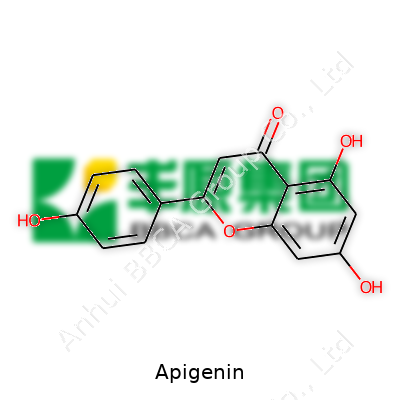
Apigenin’s chemical formula, C15H10O5, and molecular weight near 270.24 g/mol, have guided quality control teams in their standards for identification. By experience, pure apigenin resists melting until it nears 345°C, reflecting fairly high thermal stability for a small natural molecule. Its solubility takes some working around: it dissolves well in hot ethanol or DMSO, not so easily in water under ambient conditions. For users in the bio lab, that matters—proper dissolution protocols minimize wasted batch time. UV absorption peaks give another way to authenticate identity without resorting to MS or NMR each run. As a crystalline solid, it doesn’t clump or cake if the storage environment holds dry and dark, letting us guarantee shelf lives manufacturers and end users count on.
Our technical team takes raw flower or leaf material, isolates flavones, then purifies the batch to at least 98 percent apigenin by HPLC, a figure that sets the standard for pharmaceutical and nutraceutical development. Each lot runs the gamut of identity, purity, moisture, and residual solvent checks, making sure no surprises show up in the drum or the data sheet. Batches label with production date, net mass, and a lot code that lets us trace origin and test points down to the harvest. Packaging in light-resistant, airtight containers addresses oxidation and hydrolysis risk. We work to harmonize labeling with regional requirements to keep transport and import predictable for clients worldwide.
Extraction starts with careful selection of botanical materia, verified through macroscopic and microscopic analysis. Initial maceration in ethanol or methanol releases flavonoids from the plant matrix. Filtration and concentration comes next, culminating in liquid-liquid partitioning against water, which forces the less polar compounds—apigenin among them—into an organic layer. Vacuum evaporation delivers a crude solid, and further purification usually runs over reverse-phase columns to yield crystalline apigenin. Final drying under reduced pressure preserves compound integrity. A few factories have shifted toward greener methods, blending ultrasonication or enzyme-assisted extraction with eco-friendly solvents, but the best yield and cost performance still reside in finely tuned conventional solvent extraction. All these steps tie back to our core manufacturing challenge: balancing yield, purity, and environmental impact every production cycle.
The multiple hydroxyl groups on the apigenin backbone invite chemical modifications. Glycosylation attaches sugar moieties, enhancing water solubility for dietary supplement use. Methylation or acylation further tweaks bioavailability and metabolic persistence—critical for teams investigating new drug candidates. Researchers routinely derivatize apigenin to probe how slight molecular changes impact biological pathways, especially regarding anti-inflammatory and neuroprotective roles. Chemical modification often poses scalability challenges, so most industrial applications still rely on naturally derived apigenin unless modifications unlock dramatic advantages in efficacy or formulation stability. The pursuit of new derivatives continues to inspire collaborations between manufacturers and university teams.
Our teams may refer to apigenin by names including “4’,5,7-trihydroxyflavone” or simply “API.” Publications occasionally cite synonyms like “Apigetrin” when referencing glycoside forms. Trade and research documentation details these nomenclatures to keep communication clear across borders and sectors. Ingredient listings for supplement use or cosmetic blends follow IUPAC names or FDA terminology as applicable. A clean naming scheme prevents confusion in regulatory submissions and shipment documents.
Handling apigenin in manufacturing rarely turns hazardous under normal workplace ventilation and hygiene conditions. Ingestion or dermal contact with concentrated dust can cause irritation, so operators suit up appropriately and manage strict dust control. Teams rely on decades-old safety data supported by up-to-date studies to inform protective protocols. We keep all apigenin-containing residues segregated for waste treatment aligned with national and local chemical disposal laws. Process control points ensure our releases and byproducts never threaten air or water quality. In a well-managed production line, compliance never slips to an afterthought—audits and system reviews keep workspaces aligned with evolving health and safety expectations.
Pharmaceutical researchers have tested apigenin’s promise as an anti-inflammatory and anti-cancer agent. Food scientists include it in functional foods or teas for its antioxidant activity and subtle bitterness. Cosmetic developers see value both in stable color and photoprotective properties, so apigenin finds its way into creams and serums. A large share of output enters supplement markets in the US, Europe, and Asia, where regulatory acceptance supports a growing selection of apigenin-enriched capsules and tablets. Animal nutrition, too, takes its share, with studies linking apigenin to stress reduction in livestock. Whether the focus is therapeutic potential, flavor enhancement, shelf life, or appearance, the diversity of application continues to grow as regulatory frameworks open new doors.
Investment in R&D goes far beyond regular line testing or quality benchmarks. Our R&D efforts seek novel extraction and purification approaches to lower solvent use, boost yield, and close the loop on process effluents. Collaborations with pharmacologists and toxicologists bring deeper insights into each new use case. Emphasis on glycosylated and liposomal delivery systems suggests future demand will lean on engineered apigenin forms that maximize absorption and bioactivity. By tracking published studies on its biological mechanisms, we anticipate application trends that influence how we focus pilot plant trials. Our work ensures apigenin remains available in forms and purities that consistently deliver results for demanding end-users across health, food, and cosmetics.
Decades of in vitro and animal testing paint apigenin as one of the safer bioactive flavones. Standardized acute toxicity studies show that it takes doses far above what humans encounter from food, supplements, or workplace exposure before adverse effects appear. Some data points to mild gastrointestinal irritation at excessive intake, prompting labeling focused on suggested daily amounts. Chronic exposure research remains in progress, as does study into pharmacokinetic profiles for new delivery forms. Safety teams scrutinize every new batch and monitor literature for rare allergenic or interaction reports. Transparent toxicity data underpins the market access of every ton we ship.
Strong trends in natural bioactives drive ongoing demand for apigenin across several sectors. Anticipated changes in regulatory standards—especially those governing supplements and cosmetics—mean manufacturers must stay nimble, updating product data and manufacturing process documentation at a moment’s notice. Advances in fermentation and plant cell culture could start supplementing or replacing field-grown plant sourcing, particularly if price fluctuations impact scale. Enhanced solubility forms will support next-gen dietary supplements and APIs. The search for new therapeutic indications, combined with consumer appetite for traceable ingredients, motivates continuous improvement in our extraction efficiency, product purity, and technical support. The next wave of research into apigenin’s benefits and applications will depend on integrated efforts from biologists, engineers, and chemical manufacturers working together to meet evolving standards and market needs.
Apigenin stands out in our industry for its presence in many plants, including chamomile, celery, and parsley. Unlike synthetic compounds, apigenin comes directly from nature. In our years of working with this flavonoid, the repeated interest from research teams, nutraceutical formulators, and direct end-users has validated its value for health improvement.
The most talked-about benefit relates to its antioxidant activity. Oxidation in the human body accelerates aging and plays a role in chronic disease development. Apigenin addresses this challenge by neutralizing free radicals, cutting down cell damage. This direct effect on cellular health explains why formulators reach for our apigenin when developing supplements aimed at long-term wellness.
Apigenin’s role doesn’t stop at antioxidant properties. Demand for our apigenin rises whenever there is new research about its influence on stress response and sleep quality. Evidence points to its interaction with GABA receptors, which has made it a subject of studies focused on anxiety and sleep disorders. Customers have shared stories of seeing relaxation and improved sleep among groups testing finished products with apigenin as a key ingredient.
Cancer researchers continue tracking apigenin due to its potential to affect multiple signaling pathways involved in the growth and spread of abnormal cells. While much reporting gets ahead of the data, in-house feedback from partners in oncology research highlights the real excitement about apigenin’s future in adjunct therapies. Demand for higher-purity material reflects this trend.
Heart health drives another major area of application. As cardiovascular conditions challenge health systems worldwide, formulators look for compounds that support vascular health and cholesterol management. Lab collaborations using our apigenin have zeroed in on its anti-inflammatory properties and their implications for blood pressure regulation and arterial protection. Real-world testing continues to inform formulation adjustments to optimize these effects.
Shifting to metabolic health, recent inquiries focus on apigenin’s potential influence on glucose metabolism. Directions in preclinical data show promise for supporting those managing blood sugar fluctuations. We have responded by refining isolation and purification steps, making it easier for researchers and supplement makers to assess apigenin’s usefulness in this area.
Sourcing methods and purity matter as much as the compound’s profile. Our purification approach tracks and limits potential contaminants, knowing that regulatory scrutiny and consumer awareness demand this. Partners trust us not just for technical expertise, but because we publish independent test data, maintain traceable supply chains, and work directly with research teams seeking consistency from batch to batch.
The challenges come with advancing clinical evidence. While animal and early-stage human trials offer hope, the human body’s response varies from individual to individual. Formulation teams must balance enthusiasm for early findings with the need for rigorous data. We encourage transparent communication between all participants—researchers, manufacturers, and end-users—so decisions rest on facts, not assumptions.
Looking ahead, apigenin’s health benefits continue to draw research funding and real-world attention. For our team, the focus never leaves quality, purity, and scientific credibility. That approach has earned respect and keeps apigenin factories running, delivering for companies and communities who see in this compound a tangible route to better health.
Manufacturing apigenin in bulk puts us in a unique position. We handle pure apigenin at its source and see both its benefits and some of the issues rarely discussed. This flavonoid, found in plants like chamomile and parsley, attracts customers looking for natural compounds to support health goals. It’s common to see excitement around natural origin, but our experience shows plant-derived doesn’t always mean risk-free.
Our technicians and chemists have contact with high concentrations of apigenin every day. Exposure in the workplace, where the materials are not diluted, provides important insights. Skin contact rarely causes noticeable problems, but those with extra sensitivity sometimes report mild irritation — nothing dramatic, usually just some redness that resolves once the area is washed. We monitor workplace air for dust; inhalation never reaches levels high enough to prompt symptoms in our staff, which lines up with published safety data. We emphasize basic lab safety — gloves, particle masks, ventilation — as a precaution, even with gentle compounds like apigenin.
Studies often focus on apigenin’s benefits: antioxidant activity, calming effects, support for metabolic and immune balance. Large collaborative reviews, including those cited by the NIH, stress how even at high doses used in animal studies, toxicity remains extremely low. Published human trials tend to use moderate amounts and rarely report side effects. Some participants mention occasional nausea or digestive upset when taking large oral doses, but these are the exception, not the rule. In clinical use, allergy risk stays low compared to more aggressive plant extracts, matching what we see day to day.
Most of the apigenin in supplements comes from extracts, purified to target levels. Pure apigenin, as we ship it, typically requires careful blending for consistent dosing. Overdosing through normal use seems unlikely, but poorly formulated capsules can alter release and increase gastrointestinal side effects. Customers sometimes report that switching to a high apigenin tea or extract gives them headaches or stomach discomfort; these likely stem from broader extract composition or pre-existing gut sensitivity, not apigenin alone. Customers using high doses for the first time often call asking about interactions with blood thinners or sedatives. There’s not enough real-world data to prove large-scale problems, but as chemists, we tell customers to consult healthcare professionals if combining apigenin with medications.
With every batch, we test purity and screen for contaminants that can introduce their own risks. Residual solvents, microbial load, and heavy metals command constant attention — more so than apigenin itself, which remains chemically stable and unreactive in finished form. Our focus remains on keeping apigenin pure and recommendations clear, because misuse rarely comes from the compound itself, but from cutting corners on quality, or using more than research supports.
Long experience has shown that apigenin, produced and handled properly, stands among the gentler flavonoids from a toxicity standpoint. Still, respect for dose, finished product quality, and medical oversight matters just as much as going “all-natural.”
Working with plants and extraction lines every day gives a practical view of apigenin that lab reports or supplement blogs rarely cover. Apigenin draws plenty of attention—users see it in scientific studies, fitness supplements, and herbal teas. For those outside the factory, it often seems like a new super-compound. Farmers bring in chamomile or parsley by the ton; our job is to turn those ordinary inputs into pure, standardized apigenin that researchers and supplement brands trust. The big question people bring up is how much to take and what’s safe.
Most apigenin on the market comes from chamomile, parsley, or celery. It is a plant flavonoid, best known for its calming effects and promising research into antioxidant activity. Academic groups keep studying its possible roles in mood and cellular health. These findings catch people’s eyes, but quantities, forms, and context matter. Simply eating a sprig of parsley won’t match the doses used in controlled studies or dietary supplements.
End users want a clear answer: “How much apigenin to take each day?” Most research uses extracts or isolated apigenin, not food itself, so amounts usually range from 25 mg up to a few hundred milligrams per day, depending on the study and health goal. Those studies often use pure apigenin, not whole-plant preparations. Human tolerance appears strong at these levels, with no distinct toxicity signs in published research, but long-term studies feel scarce. People often start on the lowest suggested amount and increase it only under medical advice.
Modern supplement brands buy apigenin in standardized forms to dose their products precisely. Manufacturers like us stress the need for accurate weighing on production lines—fluctuations in content are never welcome. Equipment calibrates by the milligram to keep dosage correct, whether filling capsules or mixing ready-to-drink health beverages. These details behind the scenes make the retail label doses possible.
Elemental impurities, residual solvents, and adulteration can ruin clean apigenin. The more people look for “natural” products, the easier it gets for suppliers to cut corners. Rigorous testing using HPLC (high-performance liquid chromatography) and heavy-metal screens protects the end user. Working at the manufacturing source means techniques like column chromatography, vacuum drying, and particle-size analysis aren’t just buzzwords—they safeguard consumer health.
Making apigenin opens a front-row seat to trends and misinformation. Social media plays up research headlines, but rarely mentions sourcing, dosing, or bioavailability. Not all supplements absorb the same way; mixing apigenin with a small amount of dietary fat appears to help uptake. Food scientists suggest this because apigenin dissolves better in lipids. Taking the product as a tea, capsule, or blended with other botanicals varies absorption rates.
After years of refining extraction methods, one fact stands out: real progress depends on informed consumers, open scientific study, and honest manufacturing. Customers asking about proper use drive the industry to stay transparent about what’s in each batch and how it should enter daily life.
For many years, our team has synthesized and supplied apigenin to research labs, nutrition brands, and the pharmaceutical sector. Apigenin’s reputation as a plant-based flavonoid mostly surfaces in discussions about wellness, stress management, or sleep support. The reality within manufacturing labs often involves a deeper look at both the strengths and possible risks of this molecule, especially when consumers explore combining it with medications or other dietary supplements.
Our technical group started seeing a growing number of end-user questions as apigenin supplements gained traction. Some wanted to blend apigenin with sleep aids, others with anti-anxiety products, or even basic multivitamins. Chemically, apigenin belongs to a family of flavonoids that interact with various pathways. It doesn’t act as a pure spectator in the body; research points to effects on enzymes like CYP3A4, which handle drug breakdown in the liver. If a person takes a medication processed by those same enzymes, there’s a realistic chance that apigenin could tip the balance, changing the strength or duration of that drug’s action.
Clinical data on apigenin remains limited compared to older plant extracts or mainstream pharmaceutical ingredients. Most safety studies focus on animal models or non-clinical settings. Reports suggest apigenin appears safe on its own at doses found in food, such as parsley or chamomile tea. The picture changes once higher doses come into play, like those in some supplement capsules. Potential for interaction goes up, especially if the user manages chronic health conditions or relies on prescription medicine. Our analytical team often flags a lack of robust human trials looking at these combinations.
We have heard from formulators who noticed customers reporting unexpected drowsiness, stomach upset, or, in rare cases, odd reactions when apigenin joined their daily supplement stack. Identifying the exact cause remains hard. Some consumers use multiple products together or change dosages without guidance. Our staff stresses the importance of transparency in supplement labeling, listing apigenin content and clear usage warnings. Current product compliance rules require this in most markets, but not all supplement companies do it consistently. We take extra steps to make sure apigenin ingredient lots remain pure and that product info gets updated as regulations shift.
One path forward is direct collaboration with medical teams and pharmacists. Before launching new apigenin-based formulas, our development group sometimes arranges advisory sessions so healthcare professionals can weigh in. Retailers want clear guidance, not just product specs. Another helpful measure involves updating Safety Data Sheets as new interaction studies surface, so downstream formulators get accurate reference documents. We also invest in internal workshops with nutrition consultants, focusing on practical examples of drug or supplement layering.
Responsible manufacturers encourage end-users to check with their physician or pharmacist when adding apigenin alongside medication or other supplements. Automated online interaction checkers don’t always catch the nuances of a new ingredient. Oversight matters, especially for people managing mood disorders, blood thinners, or central nervous system drugs. We continue tracking scientific developments, keeping both our team and our customers in the loop about safety, proper dosing, and the latest findings on possible interactions. This approach helps everyone stay safe, informed, and confident using apigenin smartly.
Working on the manufacturing end teaches a lot about which plant compounds attract researchers, doctors, and health product formulators. Apigenin, a flavonoid found in chamomile, celery, and parsley, stands out for its wide range of research-backed benefits. Our company invests effort into ensuring pure, high-quality apigenin because studies point to real, concrete potential in addressing day-to-day health challenges and supporting long-term wellbeing.
Many people reach for natural solutions when looking for ways to manage stress or improve sleep. Repeated research highlights apigenin’s influence on gamma-aminobutyric acid (GABA) receptors in the brain. By supporting a calming effect without the fogginess tied to some synthetic options, apigenin has carved a space in premium sleep and relaxation products. People want alternatives that help them unwind at the end of a busy day, and apigenin-filled extracts offer a gentler approach compared to prescription sedatives. As a manufacturer, we follow strict controls to preserve the delicate molecules so that our customers get maximum active compound per dose.
With an aging global population, interest in compounds supporting brain health grows every year. Lab and animal studies suggest apigenin goes beyond relaxation—it appears to help protect nerve cells from age-related decline and may support new brain cell formation. As manufacturers, our responsibility goes further than shipping a powder. We invest in extraction and purification technologies that keep this molecule highly bioavailable, providing the foundation for new supplements targeting memory and cognitive function. Researchers investigating neurodegenerative diseases have included apigenin in their test compounds, and we follow this field closely for future directions.
Modern life exposes people to sources of chronic inflammation—from environmental pollutants to the stress of overwork. Flavonoids like apigenin demonstrate ability to blunt inflammatory responses within cells. In our facilities, we constantly evaluate raw material sources for consistent apigenin content to meet the quality standards demanded by supplement and functional food companies. Several studies describe how apigenin can modulate the production of signaling molecules such as cytokines, often out of balance in chronic conditions. More product developers seek standardized plant-derived ingredients for immune health blends, and apigenin consistently attracts their interest.
Apigenin research also covers the hormonal sphere. Investigations suggest a supporting role for women dealing with discomfort during menstrual cycles or menopause, as apigenin may interact with enzyme pathways involved in estrogen metabolism. Manufacturers like us field questions about purity and consistency because customers want peace of mind regarding what goes into their products, especially when hormone fluctuations are involved. Every run of apigenin we ship meets strict identity and purity checks for this reason.
It makes a difference to know where your ingredients come from. By investing in robust testing, supplier partnerships, and transparent manufacturing practices, we make sure each batch of apigenin supports health outcomes confidently. With ongoing clinical research and growing consumer demand, manufacturers fill a unique role—bridging reliable science, careful production, and trust in every lot produced.