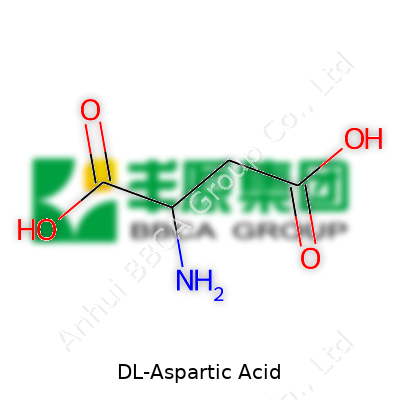
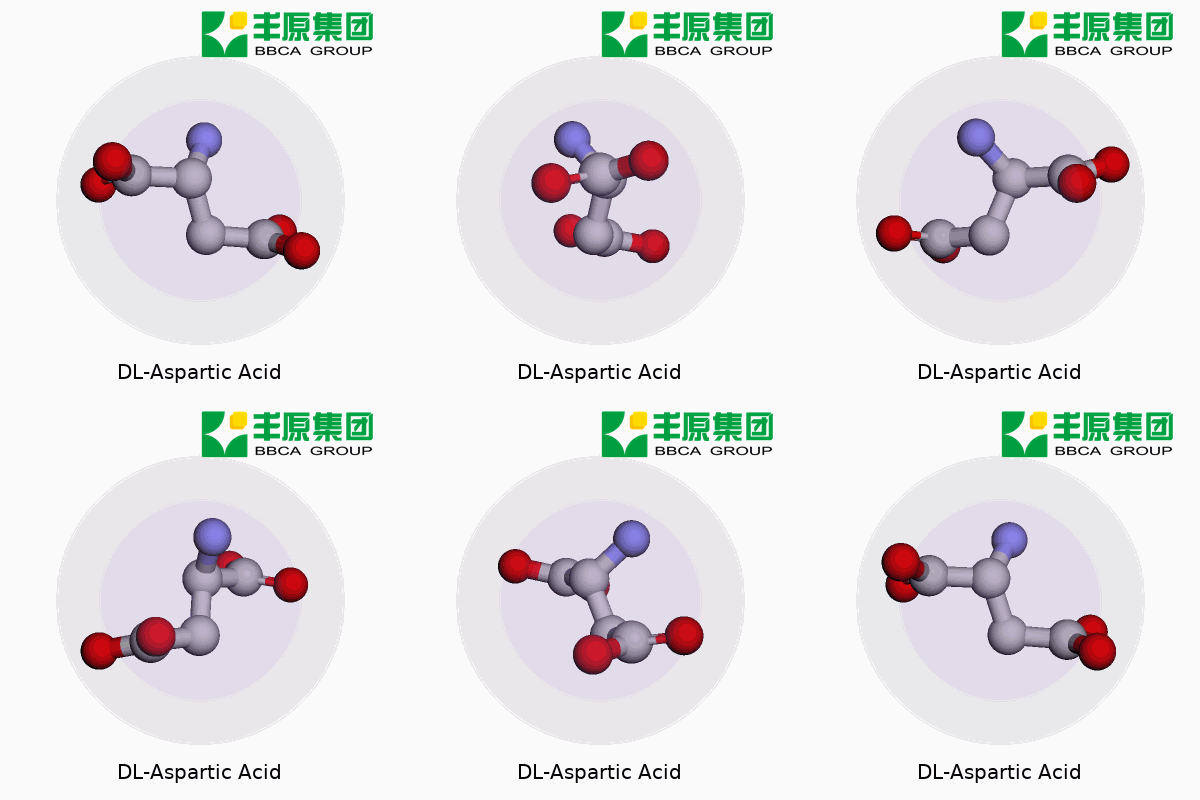
The story of DL‑Aspartic Acid stretches back to the 19th century when chemists extracted its natural forms from plant sources. Racemic aspartic acid, the type produced by our facility, became relevant with the advance of stereochemistry and amino acid research in the early 20th century. By the 1950s, wider-scale production became possible as synthetic chemistry matured and analytical tools could distinguish the two enantiomers with accuracy. Our manufacturing lines reflect both the precision required by the pharmaceutical industry and the growing practical demand in food, feed, and specialty chemical sectors. Over decades, shifts in analytical rigor and quality requirements have forced us to constantly upgrade purification steps, impurity control, and batch-to-batch reproducibility.
We see DL‑Aspartic Acid as more than a straightforward amino acid. It carries the molecular formula C4H7NO4, forming a white, crystalline powder under standard conditions. This racemic mixture contains both D and L enantiomers in equal measure. Many users focus on the L-form for biological incorporation, yet the DL form keeps gaining ground in technical and industrial applications. The product holds a faintly acidic taste and remains highly soluble in water, sparingly soluble in ethanol, and almost insoluble in ether. That mild, sharp taste guides its use in flavor preparations, but more often the discussion centers on purity levels, solubility curves, and lot consistency. Shelf-stable in cool, dry storage, DL-Aspartic Acid remains robust under ordinary ambient conditions, which matches well with modern inventory control and bulk handling systems.
DL‑Aspartic Acid crystallizes in prismatic needles or a granular powder, with a melting point around 270°C (with decomposition). The pKa values at physiological temperature make it suitable for buffering and chelation work. From the manufacturing side, its straightforward solubility in water allows direct testing during QC and simplifies downstream incorporation into aqueous blends. We regularly check optical rotation to confirm racemic composition; true DL batches show zero rotation. Chemically, the free carboxyl groups grant reactivity toward esterification, salt formation, and peptide coupling, which tie into the functional applications in drug synthesizing and chiral switch studies.
Our technical sheets set benchmarks for appearance, purity by HPLC, heavy metals content, and moisture levels. Typical purity requirements fall above 99%, as many downstream users judge performance on both absolute content and possible trace-level contaminants. We keep close documentation of batch release, traceability, and lot-specific attributes as guided by international food, pharma, and industrial standards. Labels detail chemical structure, composition, CAS number (617-45-8), and recommended storage instructions, since clients expect transparency and trace control from source to shipment. Microbiological testing takes place for food and feed grades—hard-won lessons from years of exporting to tightly regulated regions.
Most large-volume DL‑Aspartic Acid starts with chemical synthesis, usually through the ammonolysis of fumaric or maleic acid or by direct Strecker synthesis using suitable precursors. The choice hinges on cost, available feedstocks, and downstream purification. Over the years, as demand and safety standards have changed, we refined our methods to cut residual solvents and streamline waste management. For high-precision grades, we use ion-exchange, crystallization, and rigorous washing to reduce inorganic residue and guarantee absence of harmful by-products. Enantiomer separation largely falls to specialized users, but our racemate serves where both D and L forms contribute to end-use, such as in technical buffer blends and research compounds.
DL‑Aspartic Acid offers two reactive carboxylic acids and a primary amine, so it opens up a world of transformation: peptide bond formation, esterification for prodrug synthesis, and conversion into asparagine through amidation steps. In our experience, the racemic mix gives a flexible base for ligand production and chelating agent synthesis, especially in agricultural micronutrient and specialized medical applications. With appropriate activation, both D and L forms couple readily to form synthetic peptides for biochemical research. Modification with metals, like forming aspartates of calcium or potassium, has become a mainstay in mineral supplementation, and our production lines continually adapt to rolling updates in global compendial standards.
Customers and partners refer to DL‑Aspartic Acid by various synonyms: 2-Aminosuccinic acid, Racemic Aspartic Acid, DL-Asparagic acid, or even its registry number, CAS 617-45-8. Product databases sometimes label it as 2-Aminobutanedioic acid. Local markets lean into nicknames, but precision matters, especially when logistics, customs, and cross-border sales demand clear documentation.
Our team recognizes the expectations set by GHS, REACH, and other regulatory regimes. Handling and storage routines minimize dust formation and keep product uncontaminated. Granule size, packing integrity, and labeling enforcement feed into occupational safety codes we update yearly. Acute toxicity remains low, but PPE remains mandatory in our plant—gloves and goggles keep the powder from skin and eye contact, and we provide full documentation for SDS as soon as a new lot comes on line. UP to date, new product safety training covers spill management, disposal, and allergen risk controls, since the final customer application often extends to sensitive food, supplement, or pharma segments.
Over time, DL‑Aspartic Acid found roles outside the classic protein context. Sports nutritionists target it for its link with metabolic function, and some animal feed makers include it for balanced amino acid profiles. Pharma formulators reach for it as a chiral pool building block and for synthesizing specialty APIs. Technical markets pull in DL-form for buffer formulations, metal chelation, and precursor use in specialty ligand production. The expansion of research in neurobiology and hormone synthesis has made racemic lots more valuable in experimental protocols. We constantly interact with customers in each sector to tweak quality grades for actual application, driving us to adapt both documentation and underlying manufacturing methods.
R&D sits at the core of our competitiveness. Projects on enantioselective synthesis keep gaining ground, as new catalysts and process intensification offer the dual benefit of reducing cost and increasing product specificity. Rising demand for ‘green’ amino acid synthesis has led us to scrutinize both raw material origin and solvent recovery schemes, drawing from years of working alongside academic partners and multinational clients. We invest in real-world pilot plant studies, testing not just theoretical yields but also reproducibility under full manufacturing conditions. In the last decade, projects investigating DL‑Aspartic Acid’s role in neuroendocrine function and peptide design have opened up contacts with biotech and diagnostics firms, shaping batch formats and certification focus.
Toxicology profiles drive both regulatory compliance and customer peace of mind. Historical data and more recent in vivo studies underscore generally low acute and chronic toxicity for DL‑Aspartic Acid at application-typical concentrations. Our Quality Assurance keeps up with evolving thresholds, as regulators across regions set different limits for heavy metals, residual solvents, and microbial purity. Long-term studies with rodents and data from food use show the racemic acid offers high safety margins, but we do not let up on batch testing—especially when changes in raw materials or process adjustments occur. Traceability now goes right down to solvent lots, filtered water, and packaging origin. This continuous vigilance builds trust and minimizes risk for both plant staff and end users.
Looking ahead, DL‑Aspartic Acid’s place in specialty manufacturing grows stronger as technology steers toward tailored molecules and multi-purpose ingredients. Trends in synthetic biology may blur the line between D and L forms, and industrial fermentation can offer new feedstock pathways, challenging traditional petrochemistry. Zero-defect quality and eco-conscious sourcing will set new entry bars, leading producers like us to re-examine everything from energy use to packaging recyclability. Research into novel medical, agricultural, and technical uses expands every year, much of it in partnership with universities and technology developers. The push for automated real-time analytics in the plant will further tighten process control and lot release speed, serving a market where traceability and compliance demand sharper data than ever before.
Having handled DL-Aspartic Acid for years in our facility gives us a close-up view of how this compound affects different sectors, especially health and nutrition. We see its entire journey, from amino acid extraction to finished product, and that hands-on perspective tells a more practical story than you’d get just looking at chemical properties or internet summaries.
Aspartic acid is classified as a non-essential amino acid. The “DL” variant we help produce contains both D- and L- forms, giving it more versatility than the pure L-form found in natural proteins. Across our clients, many in supplements and sports nutrition, the key draw comes from DL-Aspartic Acid’s role in supporting the body’s own amino acid pools—think protein synthesis, cell signaling, and maintaining proper muscle metabolism. Anyone who’s pushed their body hard in the gym or seen how quickly the body repairs itself after heavy exercise recognizes this underlying importance. The D-form isn’t commonly found in food or the body but appears to influence certain neurological processes; our technical team has reviewed scientific findings pointing to effects on cognition and hormone regulation. Some supplement manufacturers turn to DL-Aspartic Acid for these combined properties, seeing opportunities beyond simple muscle support.
The media often talks about DL-Aspartic Acid as a “testosterone booster.” Reviewing lab studies, we know the D-form interacts with the endocrine system, signaling glands in the brain to promote hormone release. That said, the real-world effects in humans remain a topic of discussion in the clinical community. The compound’s chemical structure allows it to be rapidly absorbed and processed, making it popular in pre-workout blends. We regularly conduct purity assessments and particle size checks to match supplement producers’ expectations, since performance-focused users accept no compromise in ingredient quality. We always encourage transparency with consumers on realistic outcomes; the benefits connected to hormone levels don’t equate to magic solutions, just possible support in conjunction with a healthy lifestyle.
In our production schedule, DL-Aspartic Acid pops up not just in the sports category but also in formulas used in cognitive health, specialized functional foods, and even some interdisciplinary research on neurotransmitter function. Researchers continue to explore how the D-form participates in the synthesis of N-methyl-D-aspartate (NMDA), which is linked to learning and memory processes. Our batches must meet rigorous purity levels for these sensitive applications—offering clean material free of contaminants enables more reliable scientific studies. Some partners experimenting with blends focused on mental clarity or anti-fatigue attributes see DL-Aspartic Acid as a building block, not a standalone star. Its value grows as more discoveries come in connecting amino acid chemistry to brain health.
From a trust perspective, quality control sets the bar. Our technicians test every lot for residues from processing, unwanted by-products, and consistent enantiomer ratios. Inaccurate labeling or adulterated mixes disappoint customers and disrupt research. The market has seen issues with inferior powder supplies or mislabeled batches—sticking to recognized standards avoids any confusion and promotes wider acceptance among end users, from athletes and bodybuilders to clinical researchers. We stand behind the ingredient’s potential, captured through careful handling, honest production, and a willingness to stay up-to-date with new developments. DL-Aspartic Acid’s story is still being written, and as part of that supply chain, we are committed to supporting further discovery.
Working on the production line and in product quality labs, I’ve handled DL-Aspartic Acid thousands of times. Conversations about daily supplementation often make their way to our plant floor, sometimes carried by colleagues who lift after hours or customers interested in using it every day. Opinions bounce around, but as someone who’s seen its journey from raw feed stock to shipment-ready barrels, I believe some facts add clarity to the noise.
DL-Aspartic Acid—different from its purely L- form used by the body—contains both D- and L- isomers, making it a racemic mix. No complex jargon needed—the L-form gets built into proteins and has a history in food and nutritional products, including sports supplements and flavor enhancers. The D-form shows up in some organisms but doesn’t play much of a role in metabolism for most people.
In manufacturing, we never rely on stories or fads. Consistent records show DL-Aspartic Acid doesn’t break down into known toxins under normal storage. Practically, spills or routine exposure to the powder or solutions during batching haven’t caused chemical burns, respiratory irritation, or allergic reactions among operators. We use standard PPE for dust control, just like with citric acid or other amino acids.
We make DL-Aspartic Acid using a reliable synthesis process. Each batch gets checked for byproducts, heavy metals, microbiological load, and purity. Any batch that fails these limits doesn’t leave the plant—simple as that. As a manufacturer, safety isn’t a market catchphrase; it’s verified in our lab and seen in the lack of incident records tied to routine exposure.
That said, how consumers use it matters just as much. We stick to documented safe dietary levels. For amino acids, that’s usually up to a few grams per day, in accordance with published nutritional research. DL-Aspartic Acid isn’t essential—meaning your body makes enough L-Aspartic Acid for daily needs, drawn from a wide diet.
Some outlets push DL-Aspartic Acid as a testosterone booster, but human trials provide mixed evidence—sometimes showing increases, sometimes not. The largest studies suggest regular doses under 3 grams a day don’t act much differently in the body than L-Aspartic Acid, but exceeding this range hasn’t been studied long enough to call it safe without question.
Metabolic fate matters. Excess amino acids often get converted and filtered out, but rare cases involve kidney or liver issues in people with preexisting problems. For healthy adults, regulators rely on toxicity data showing no effects at typical supplement doses, but children, pregnant or breastfeeding women, and those with chronic illnesses should not be the target consumers.
Amino acid supplements, including DL-Aspartic Acid, rely on good manufacturing and responsible labeling. We have a stake in this—quality lapses reflect poorly on all chemical producers. Legally, nutritional products must stick to purity and dose standards set by food safety authorities. Randomized audits help enforce these rules. Clear labeling and batch testing add extra security. A bottle that says “DL-Aspartic Acid 1 gram per serving” should contain exactly that—neither more nor less.
Confidence in chemical safety grows with transparency, strong controls, and continuous review of emerging health data. As the manufacturer, we owe this diligence to every end user—be it an athlete, food scientist, or regular supplement customer.
Out here making DL-Aspartic Acid, daily work keeps us close to the way this amino acid travels from raw material to finished powder, then on to supplement companies and industrial customers. Dosage is a question buyers raise every week—people want to get real answers, not catalog copy or sales talk. It helps to lay out the learned and practical take from inside the manufacturing side.
Most sports nutrition and supplement firms ask about 2 to 3 grams as a serving amount for adult formulas that use DL-Aspartic Acid. This comes from published studies, not just marketing advice. Studies in the field observe 3 grams of D-Aspartic Acid daily for boosting male hormone levels, but DL is a racemic blend with somewhat reduced bioactivity compared to pure L- or D- forms, so typical use lands slightly lower per dose. Corporate buyers often target the middle ground: 2 grams is enough for inclusion while keeping cost and label claims in check. Nobody wants a product recall for overdosing an ingredient, so brand holders stick close to clinical numbers rather than guessing high or low.
Problems come less from the amount—provided buyers stay near science-backed levels—and more from quality. Some brands try to cut costs by sourcing from resellers who dilute grades for higher profit. If the supply chain includes bulk blends or fillers, no amount of label math saves the finished product. Reliable input always makes a difference. A kilo of true DL-Aspartic Acid from a manufacturer testing every batch gives transparency in what lands in every drum. You want HPLC COAs and clear origin, so whether you dose 1, 2, or 3 grams, the customer gets what the formula promises. As a direct manufacturer, we see what happens when supplement makers switch to questionable sources to save a few cents; complaints, recalls, and wasted material follow soon after.
Tossing higher doses into a product doesn’t bring more benefit, just more risk. Unwelcome side effects often show up above 3 grams, mostly digestive upset or headaches. No brand leader wants to see their name linked to these issues, so most avoid doses at the high end. We’ve fielded enough customer calls from pilot launches to see that less really is more. Simple blends work better and have fewer returns. Sticking to the known, science-based range also reduces headaches with regulatory filings, since labeling regulations pay close attention to ingredient amounts, especially when they climb much above common levels. That’s smart business on both the compliance and the public health side.
Direct feedback from supplement clients reminds us that clear dosing instructions help prevent misuse. A good label includes the ingredient amount per serving and straightforward safety notes—no fine print or fuzzy numbers. On our end, providing easy-to-read documentation helps each downstream partner do their job while maintaining safety for the end user. Open records and chain-of-custody keep both brand and consumer secure. Advising 2 to 3 grams isn’t guesswork: it follows what works and won’t raise flags from nutritionists or regulatory agencies.
Total honesty, plus routine testing and consistent grades, lets everyone in the supply chain sleep better at night. That’s the kind of motto any real manufacturer can get behind.
Daily, we oversee batches of DL-Aspartic Acid as it moves from our reactors through filtration, drying, and final packaging. This amino acid enters a range of products, from dietary supplements to specialized feed mixes. Over the years, safety questions always follow when an ingredient grows in popularity. Reports about potential side effects of DL-Aspartic Acid have circulated, especially as fitness communities and researchers evaluate its role in hormone regulation. As a manufacturer, we find it important to separate noise from valuable information, focusing on facts and experience.
Each lot we produce comes with a certificate of analysis, confirming chemical identity and the absence of common impurities. The pure DL-form, a combination of D- and L-aspartic acids, structurally matches non-essential amino acids present in many natural protein sources. Most safety concerns arise from overconsumption or extended high doses, not from trace impurities or the compound itself when produced to pharmaceutical or food-grade standards.
Through our collaboration with research partners, we see that moderate intake aligns with how the human body already handles related amino acids. The material passes through the same metabolic pathways as its counterparts found in meat and vegetables. Any theoretical toxicities generally require dosages far above recommended supplement guidelines. To date, published studies on DL-Aspartic Acid rarely demonstrate long-term harm in healthy adults, provided intake remains reasonable.
Sometimes, customers look for quick performance gains and exceed labeled dosing instructions. Anecdotal reports then mention headaches, digestive upset, or mood swings. Scientific literature points to occasional changes in hormones and neurotransmitters when DL-Aspartic Acid is consumed well above nutritional levels. Individual tolerance varies. Anyone with pre-existing kidney disorders, metabolic conditions, or who is pregnant should avoid unsupervised supplementation.
Children should not receive aspartic acid supplements without a doctor’s advice. As with any additive, if someone notices new or worsening symptoms after starting a supplement, discontinuing use and consulting a medical professional is vital.
Our goal is transparency right from raw material sourcing through to the finished product. Every drum leaving our facility contains traceability records and batch-specific quality data. We work with customers to ensure clear labeling and to support fact-based education. Regulators in many regions now require even more stringent documentation, and we support this through ongoing investment in analytical systems.
Consumer expectations keep rising. As manufacturers, we can’t control misuse or false marketing by unrelated parties, but we do support open channels for feedback and safety data sharing. Responsible formulation, thoughtful labeling, and non-misleading marketing set the foundation. Teams must analyze every batch and never cut corners on purity or documentation, especially as internet sales push DL-Aspartic Acid into new, poorly regulated markets.
From inside the plant, we see the difference between a quality-controlled amino acid and the unknowns of home-blended or questionable imports. Science, close monitoring, and honest communication have proven best at minimizing risk. Staying engaged with research and the needs of actual users, we keep refining processes and, where needed, improve the dialogue around side effects—no matter the trend of the day.
In chemical production, the differences between DL-aspartic acid, L-aspartic acid, and D-aspartic acid go far deeper than just names on a bag. These labels refer to the molecular "handedness," a topic that’s part of our daily world as a manufacturer. The concept is simple: just as your left and right hands mirror each other, some molecules do too. In practice, these variants act differently in everything from food processing to pharmaceuticals.
L-aspartic acid shows up consistently in living organisms. Chemistry textbooks often call this the “naturally occurring” form, but for us, it means working to replicate what’s found in plant proteins and animal tissue. This version is vital for the food and supplement industries since it contributes to protein synthesis. Our process isolates or synthesizes L-aspartic acid with a focus on keeping strict stereochemistry because customers in nutrition, pharmaceuticals, and biotech rely on the biological activity that only this version supports.
We have learned that, for pharmaceutical drug formulation, small shifts away from the L-form usually break or reduce function. Regulators require proof the ingredient is the correct “hand,” pushing us to develop reliable chiral separation and synthesis methods.
The D-form stands out due to its rare natural presence, but it holds growing attention in research. In manufacturing, creating D-aspartic acid isn’t about going with the flow of nature, but about heading upstream. The production calls for enantioselective synthesis, or chiral resolution, to ensure separation from its L counterpart. This process adds steps and cost.
Emerging studies point to D-aspartic acid's functions in animal reproductive biology, particularly hormone synthesis. As a result, ingredient buyers in experimental supplements and research labs regularly ask for single-enantiomer purity. Ensuring high D-purity remains a technical challenge, pressing us to refine our methods to avoid traces of the L-form mixing in.
DL-aspartic acid tells a different story. Here, both forms appear in equal amounts, resulting in a “racemic” mixture. This variant often comes from straightforward chemical synthesis, without chiral controls.
Cost-saving is the key driver for demand. When customers don’t need biological activity that’s specific to either the L- or D-form, DL-aspartic acid suits applications like technical-grade chemicals or simple pH adjusters. For us, production is more efficient because we avoid the expense of chiral separation. That said, buyers seeking pharmaceutical or food ends usually steer clear of the racemic version unless they’re certain both forms serve their use case safely.
As regulations worldwide tighten around ingredient contribution to biological or medical products, manufacturers like us keep investing in technologies for better purity, traceability, and documentation. The main challenge lies in making production processes robust enough to guarantee single-enantiomer products when claimed, along with verifying through repeated lab testing.
In daily practice, cross-contamination from shared equipment or even mistaken labeling can create serious setbacks. It takes not just good process chemistry but discipline throughout the supply chain—starting with our facilities and continuing through to the end user.
Ultimately, understanding which form of aspartic acid matches the customer’s end use shapes everything from the raw materials we buy to the methods used in packaging and shipping. Those decisions impact not just quality and cost, but the real safety and effectiveness of products downstream.