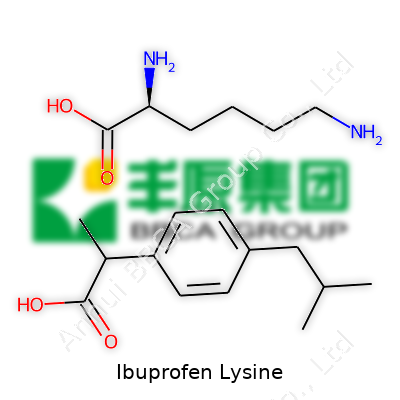
Ibuprofen Lysine represents both an extension of inventive pharmaceutical chemistry and a response to genuine healthcare challenges. This combination surfaced from the pursuit to improve solubility and absorption compared to older forms of ibuprofen, especially in acute care settings. After the initial discovery of ibuprofen in the 1960s, decades of manufacturing have made us keenly aware of the limitations in formulation and delivery methods. Chemists sought to broaden ibuprofen's clinical reach, particularly for patients requiring faster onset of relief or those with compromised digestive tracts. The lysine salt form eventually found acceptance in hospitals, especially for critical care of preterm infants vulnerable to patent ductus arteriosus, and for patients needing rapid pain relief. Our archives from the past twenty years show how early trial batches brought formulation hurdles, especially during crystalline salt precipitation and stabilization, but ongoing improvements have resulted in a product that delivers consistent advantages over the base compound.
Our ibuprofen lysine starts as a white to almost white fine crystalline powder with an odor profile nearly neutral, making it suitable for oral and parenteral preparations. The molecular formation, a combination of ibuprofen and lysine in a 1:1 molar ratio, gives better water solubility compared to racemic ibuprofen. As chemists, we pay close attention to maximizing purity, minimizing potential byproducts, and ensuring batch-to-batch reproducibility. The process requires precision at each phase: raw material procurement, reaction monitoring, filtration, and controlled drying. Quality assurance demands strict adherence to established limits for related substances and residual solvents—a direct result from years of regulatory scrutiny and batch recalls across the broader industry.
Our routine analytical work focuses on key physical and chemical parameters: melting point (typically above 150°C for the salt), high water solubility (greater than 100 mg/mL at ambient temperature), and a slightly acidic pH in aqueous solution. Spectroscopic analysis gives a distinctive signature: strong UV absorbance at 220 nm and sharp IR bands reflecting lysine’s amine and carboxylate groups binding to the ibuprofen molecule. As a solid, ibuprofen lysine flows easily through manufacturing equipment, though care must be taken to control humidity as caking can occur if storage protocols are ignored. Chemically, the salt demonstrates stability under standard ambient conditions but will degrade under extended exposure to high temperature and moisture, as we have observed in our long-term stability studies.
Technical scrutiny does not end with synthesis. Our documentation team ensures every outgoing batch matches assay limits, typically above 99% active ingredient by HPLC with defined impurity thresholds. Water content, determined by Karl Fischer titration, falls well below one percent. Packaging carries clear shelf life dates, storage instructions (dry place, below 25°C), and guidance on handling. Labels must highlight its intended medical applications, potential for adverse reactions, and directions for use. International regulatory authorities keep us vigilant, and as API manufacturers, labeling reflects both region-specific codes and up-to-date safety science. Every deviation identified by our QA audits sparks a corrective review and ongoing improvements in both grounds-up process and labeling language.
Synthesis begins with high-grade ibuprofen and pharmaceutical lysine, mixed in carefully metered amounts. Reaction occurs in aqueous or hydroalcoholic medium under strict temperature control, and salt formation completes as the mixture reaches equilibrium. Filtration steps remove insolubles, followed by drying under vacuum or gentle heat. Early adopters of this process faced scale-up problems: filtration bottlenecks, foaming, and clogging. Our teams, through incremental improvements and continuous process verification, have learned to adjust pH, optimize agitation, and tweak filtration membrane grades with each commercial-scale batch, reducing cycle times and boosting yields. Any unreacted starting materials are recycled, both for cost reasons and to reduce environmental waste.
Creating ibuprofen lysine centers on acid-base neutralization, but post-synthesis, minor modifications help tailor the finished material to specific needs. Through optional micronization, we control particle size, directly influencing dissolution rate in oral dispersions and injectables. We have collaborated with pharmaceutical partners on coating variations and granule compaction to test taste-masking and controlled release properties. Analytical chemists stay alert for byproducts, such as diketopiperazines, that can emerge if the reaction mixture overheats or lysine decomposes. Spectral and chromatographic fingerprinting confirms that the chosen reaction and purification sequences minimize risks.
Ibuprofen lysine is known in technical circles by several names: ibuprofenium lysinate, ibuprofen mono-lysinate, or simply the lysine salt of ibuprofen. Global pharmacopoeias and monographs may reference one or more of these names. In different regions, pharmaceutical packaging sometimes brands the drug as "ibuprofen lysinate" or pairs it with trade names for pediatric or hospital use. Staying current with synonym listings helps our compliance team navigate international shipment regulations as well as harmonize labeling documents.
Safety considerations cut across production, packaging, and shipping. Our facilities equip staff with PPE, scrubbers, and containment protocols to manage dust and airborne powder that can lead to respiratory irritation. Material handling SOPs align with GHS labeling, and we run regular drills for chemical spills or accidental exposure. Waste streams from synthesis and cleaning routes are neutralized and documented. Sharing process safety learnings at industry consortiums helps the sector avoid past accidents and adapt to new regulatory requirements.
Ibuprofen lysine sees use in both general pain relief and specific clinical scenarios. Clinics and hospitals order bulk amounts for formulating neonatal injectables to treat ductal closure in preterm infants. Adult and pediatric markets call for oral dispersible formulations, tablets, and sachets where fast onset is desirable. Feedback from hospital pharmacists and clinical procurement teams regularly inform our product development cycles. Seasonal demand spikes often link to local virus waves or increases in sports injuries, and our production teams know to ramp batches accordingly. Feedback loops between our labs and prescribers have improved packaging designs and tamper prevention as well.
R&D investments have focused on stabilizing the salt over long supply chains and harsh environments. Teams routinely screen alternative excipients to boost palatability and to support new dosage forms, including orally disintegrating films and injectables for low-resource settings. Formulation scientists at our site design dissolution studies and bioequivalence models to guide both innovator brands and generics partners. We track every published study from academic groups on the clinical impact of ibuprofen lysine, and initiate cooperative trials when new evidence suggests a possible benefit or risk.
Toxicologists in our group analyze both acute and chronic exposure impacts in line with evolving international guidance. They pay attention to renal and gastrointestinal effects, supporting clinicians through detailed impurity profiles and toxicokinetic data. Animal studies and post-market surveillance assist in adjusting permissible daily exposures and highlight rare adverse events. As manufacturing chemists, we accept that product safety never achieves finality—instead, it evolves with ongoing science. Emerging reports push our investigation of trace byproducts and process contaminants and lead us to refine purification and testing steps.
The future for ibuprofen lysine looks to move beyond single-use dosage forms toward integrated therapies and broader access, especially across developing markets. Medical researchers aim to expand indications beyond patent ductus arteriosus into acute migraine relief and surgical recovery aids. Our innovation group explores alternate routes of administration, including transdermal and sublingual, balancing rapid absorption with shelf stability. As the world demands faster, safer pain relief, we adapt manufacturing and supply chains to new regulatory environments, supporting both branded and generic medicine pipelines. Each advancement reflects hard-won lessons from hundreds of batches and thousands of feedback loops between lab, plant, and clinic, driving our team to pursue science-based solutions over shortcuts.
Every day, hundreds of manufacturers like ours handle the synthesis of ibuprofen lysine. Over the years, demand has shifted from standard ibuprofen to its lysine salt. Market trends come and go, but repeated orders teach you what really sticks in clinical practice. Ibuprofen lysine caught our attention years ago, not just as a chemical salt, but because of its growing relevance in both adult and pediatric medicine.
Ibuprofen lysine delivers proven relief in headaches, muscle aches, dental pain, and inflammatory conditions. Hospitals rely on it for rapid action in post-operative care. One area where our clients in healthcare have reported particular value is neonatal care—preterm infants often develop a heart condition called patent ductus arteriosus. Standard treatment brings its own side effects and absorption delays. Ibuprofen lysine, though, gets absorbed quickly and shows good results in closing this duct. The natural question for a manufacturer is always about real-world outcomes, not just chemical performance, and clinical feedback reinforces our sense of purpose.
Pharmaceutical partners moved toward ibuprofen lysine for its much improved solubility and rapid onset. In plain terms, the body picks it up faster because the lysine salt dissolves almost immediately in water. Paracetamol and regular ibuprofen don’t always match this speed. Faster absorption means quicker relief for the patient and hospitals notice a smoother workflow when time is critical. We have run parallel batches and witnessed short mixing and processing times, thanks to the granular, easily dispersible nature of this compound.
No process runs perfectly on the first try. Large-batch production of ibuprofen lysine gives a few headaches of its own: controlling purity, preventing excess moisture uptake, and monitoring the reaction temperature. After several cycles and collaborating with researchers directly, we improved our purification steps and drying technologies. That attention to process sharpens up product quality, which in turn supports healthcare staff treating vulnerable groups.
Hospitals and regulatory authorities want to know not just what goes into making ibuprofen lysine, but also how reliably and safely we produce it. Our lines run under strict Good Manufacturing Practices. We regularly review analytical data to ensure every shipment matches pharmacopeia standards. Batch-to-batch consistency and robust contingency planning prevent stock shortages, keeping supply continuous—even when global logistics hit a snag.
Efforts to cut waste and lower the environmental impact of our processes benefit everyone in the value chain. We continue investing in cleaner solvents, energy-efficient reactors, and better process design. These efforts echo the shift in public expectations around pharmaceutical manufacturing today. An industry that balances reliable supply, speed, safety, and environmental responsibility better serves healthcare needs and public trust.
Ibuprofen lysine occupies a central space in modern pain care and specialized neonatal medicine because of its rapid absorption and reliable results. Decades in the field have shown us that thoughtful manufacturing, informed by feedback from the front lines of healthcare, isn’t just a technical issue—it shapes the quality of care patients receive worldwide.
Every day on our plant floor and in our quality lab, ibuprofen and its derivatives are more than buzzwords, they're substances we understand on a molecular level. Regular ibuprofen has been a staple in pain relief for decades. Formulators across the globe use the free acid form for everything from over-the-counter tablets to suspensions. Ibuprofen lysine, though, is a salt form that changes how the drug behaves. The distinction isn't just textbook chemistry—it shapes real outcomes in manufacturing and, more importantly, for those swallowing the pill.
The free acid form of ibuprofen doesn't dissolve easily in water. You can see this challenge in production: a cloud of undissolved particles slows down both research and manufacturing. Tablet presses work harder, suspension formulations risk gritty textures if you’re not precise. By forming a salt with lysine, a natural amino acid, ibuprofen takes on new characteristics. The lysine salt dissolves much faster in water. This matters for two big reasons—first, it helps us speed up production by reducing step times, and second, it often leads to a more predictable outcome on the shelf.
Fast dissolution doesn’t only matter in our reactors. Ibuprofen lysine, with its higher aqueous solubility, tends to absorb more rapidly in the human body. The science here draws on direct pharmacokinetic studies—ibuprofen lysine reaches peak plasma concentrations faster than the acid form. For manufacturers, this difference calls for careful planning; we have to validate every batch, because the salt form can change not just on paper but for the consumer in their moment of need.
We see ibuprofen lysine pop up in hospitals, especially for neonatal use. Sometimes it shows up in pain-relief products aimed at offering faster relief. The reality on our production lines reflects global preferences. While cost tends to favor regular ibuprofen, clinical requests for rapid onset drive up interest in the lysine salt. Both forms meet a real-world need, but the environment dictates which properties developers can prioritize.
Ibuprofen’s bitterness is notorious among formulation chemists. The lysine salt, by shifting chemical interactions, allows better masking in liquid products—especially important for children or those unable to swallow tablets. That changes decisions about flavoring, colors, and packaging. In our years of designing blends for customers, those differences in bitterness, particle size, and stickiness all cycle back to the manufacturing costs and patient experience.
On the factory floor, small details make or break a process. Ibuprofen lysine usually offers more flexible handling compared to the sticky, poorly flowing acid form. That trickles down to fewer batch failures and more consistent quality. In our experience, the choice between lysine and regular ibuprofen reflects understanding how physical chemistry, processing realities, and clinical needs connect. Any new project sparks debates on solubility, taste, and cost—debates shaped by decades of manufacturing more than by trade show pitches. Real, tested experience means backing up every claim with metrics gleaned from daily production, not just product specs.
Every day, we see Ibuprofen Lysine crossing the assembly line, intended for pain relief and fever reduction. We know that dosage isn’t a marketing slogan—it makes real-world differences for patients and healthcare teams. When the molecule is put into tablet or injection form, the actual amount matters. Most adult recommendations line up with standard medical guidance: single doses often range from about 200 mg to 400 mg, repeated every six to eight hours if necessary, not exceeding 1200 mg per day unless specifically directed by a physician. For children, doctors often use their weight as a guide, typically matched in milligrams per kilogram, to minimize risk of overdose or side effects.
We see what happens in manufacturing labs when tolerances slip. Too much Ibuprofen Lysine in a dose can leave patients open to side effects: nausea, stomach pain, risk of ulcers, or worse. Too little and the relief promised on the box doesn’t arrive. The responsibility starts with the raw powder, which we test for purity and assay strength before it ever sees the blending tanks.
Our line operators and QA teams don’t get to guess at the settings. Dosing equipment undergoes frequent checks, and everyone from batch record reviewers to quality control chemists has been trained to catch the smallest errors. For those making medicines for infants or the elderly, the pressure to avoid miscalculation matters even more. People at those ages face higher risk of kidney impact or gastrointestinal complications—problems that can stem from ignoring recommended dosages, using adult products for kids, or muddling the mg to mg math between Ibuprofen Lysine and standard Ibuprofen salts.
Pharmacies and hospitals often call us with questions or issues their doctors have flagged. Real people have reported accidental overdoses when dosing instructions weren’t clear, or when different Ibuprofen formulations got mixed up on a shelf. The same ingredient might look and taste the same, but a lysine salt reaches blood levels faster. These real-world events remind us to keep labels and instruction booklets clear, digestible, and reviewed by medical experts—not just marketing departments.
Manufacturers can’t direct the hands that administer the medicine, but they can offer as much accuracy and clarity as possible before it ever leaves the factory floor. We use tamper-evident packaging, well-researched leaflet content, and color-coded dosing lines on oral suspensions. When new regulatory guidance appears—like those from FDA, EMA, or the local Ministry of Health—we update processes and literature. More than once, our teams have halted a batch when a typo or layout issue put patient safety at risk.
Patients and nurses shouldn’t feel lost scrolling through technical jargon when all they want is the right dose. The people blending, filling, and inspecting Ibuprofen Lysine know that a few milligrams off the mark can upend recovery. Our job runs deeper than compliance or cost—it’s about people trusting the hands and processes that shape every tablet, sachet, or vial. In a world where pain relief is called for at any hour, those who make the medicine stand behind the recommended dosages, confident that precision at our end keeps patients safe when it counts.
In our work producing active pharmaceutical ingredients, Ibuprofen Lysine stands out as a compound recognized for its rapid relief of pain and inflammation. It’s preferred for its faster absorption compared to conventional ibuprofen, especially in hospital and pediatric applications. The benefits are clear, but so is the responsibility to help healthcare professionals and patients recognize possible drawbacks—especially side effects, which sometimes get overlooked when discussing over-the-counter medications.
Based on manufacturing feedback and pharmacovigilance updates, gastrointestinal irritation tops the list. This discomfort ranges from mild stomach upset and heartburn to more serious events like gastritis and, rarely, ulcer formation with bleeding. Even with the lysine salt improving tolerability slightly, ibuprofen’s impact on the stomach persists. Our chemists follow strict controls to ensure product purity, but no level of refinement removes these risks. Food intake with the medicine or enteric-coated tablets may reduce some irritation, but not completely.
Headaches and dizziness also appear in patient reports. These symptoms often pass quickly, but they sometimes signal intolerance or excessive use. Health workers and pharmacists need to keep this in mind, especially when advising people who combine multiple painkillers. We encourage including clear warning labels during packaging, because confusion between formulations can easily happen.
Liver and kidney function concerns cannot be dismissed. Though rare at recommended doses, people prone to dehydration, those with pre-existing organ problems, or regular high-dose users face real risk. From our batch records and post-market surveillance, sporadic cases of jaundice or kidney impairment push us to urge thorough labeling and patient screening. Early signs such as dark urine, yellow eyes, or swelling should prompt medical review. Ibuprofen, in all forms, shares these hazards—lysinates included.
Allergic responses deserve special mention. We occasionally receive clinical feedback on skin rashes or even anaphylactic reactions in sensitive individuals. These aren’t manufacturing defects; they reflect the unpredictable nature of immune responses. Our quality checks confirm content and purity, yet predicting allergic triggers remains beyond the capacity of any chemical process. We train our team to handle cross-contamination risks and trace allergens throughout the production line.
Pediatric use requires special caution. Ibuprofen lysine’s rapid absorption benefits infants and children after surgery, but dosing errors can lead to complications—sometimes quickly. Overdoses, intentional or accidental, in children lead to vomiting, abdominal pain, lethargy, and even acute renal failure. Hospital formularies often call us to clarify stability, concentration, and dispensing instructions before using in neonatal intensive care. Only through continuous collaboration with hospitals do we update our production protocols to minimize risks with these sensitive groups.
Pharmaceutical manufacturing doesn’t end with synthesis—it stretches to proactive pharmacovigilance and dialog with those who use our products. Our technical team attends regulator workshops, reviews case reports, and adapts processing techniques to minimize impurities. We encourage practitioners to stick to recommended dosages, screen for risk factors, and avoid NSAID overlap. Only with coordinated effort from factory to pharmacy can ibuprofen lysine’s benefits outweigh its potential to harm.
Ibuprofen lysine’s effectiveness is documented, yet side effects—from the commonplace to the unpredictable—make vigilance essential. Our perspective as the source of the molecule shapes everything we do, and grounds our responsibility to support safe medication use beyond the lab walls.
Years of manufacturing pharmaceutical ingredients like ibuprofen lysine have taught us that responsible communication matters as much as quality control. Ibuprofen lysine gains attention in pain management, especially as it appears in specific hospital settings, yet questions about its use during pregnancy and breastfeeding come up often. Drawing observations from our processes, regulatory reviews, and clinical science, some points stand out for anyone considering this molecule during such critical stages of life.
Ibuprofen lysine brings together a well-known nonsteroidal anti-inflammatory drug with an amino acid salt, offering slightly faster onset and improved solubility compared to typical ibuprofen. Hospitals tend to favor this form for neonatal use, like patent ductus arteriosus closure in preterm infants. These clinical settings reflect years of dosing studies, but adult applications—especially for pregnancy or breastfeeding—deserve particular caution because of the sensitive context.
No finished drug or excipient comes to market without regulatory scrutiny. The authorities weigh any evidence of fetal risk, impacts on breastmilk, and observed side effects. For ibuprofen in general, studies indicate potential risks in late pregnancy, such as premature closure of the fetal ductus arteriosus and kidney issues. International guidelines usually recommend alternative pain relievers—paracetamol, for instance—during most of pregnancy unless there is a clear clinical justification.
From our plant controls to lab benches, we see firsthand the focus on purity, trace elements, and reliable batch-to-batch quality. Patients, caregivers, and clinicians all value clear, consistent information. We field technical inquiries not only from regulatory bodies but also from formulation scientists and even consumer advocates. We emphasize that the data and regulatory stance for ibuprofen lysine during pregnancy or lactation do not differ meaningfully from standard ibuprofen: use is generally discouraged unless absolutely necessary and clearly justified by a physician.
During breastfeeding, low levels of ibuprofen do appear in breast milk, but these are considered unlikely to harm the nursing infant due to the pharmacokinetic profile and poor excretion into milk. Still, healthcare guidance often favors the lowest effective dose for the shortest time possible. Here, data on ibuprofen lysine mirror plain ibuprofen, and professional oversight remains key.
A challenge in pharmaceutical manufacturing involves balancing the need for pain relief with clear risk communication. We talk openly about possible side effects because consequences matter more than volume shipped. For pregnancy and lactation, the stakes are higher and the available clinical evidence stands limited—especially for new or modified ibuprofen formulations. This highlights the need for strong partnerships between pharmaceutical firms, clinicians, and regulatory agencies.
Ongoing research may clarify finer points on pharmacology unique to the lysine salt form. No single company can solve the entire evidence gap, but we support initiatives aiming for better maternal and neonatal outcomes. Patient safety guides every lot we produce; careful, individualized clinical evaluation decides if any ibuprofen product has a place during pregnancy or while breastfeeding.