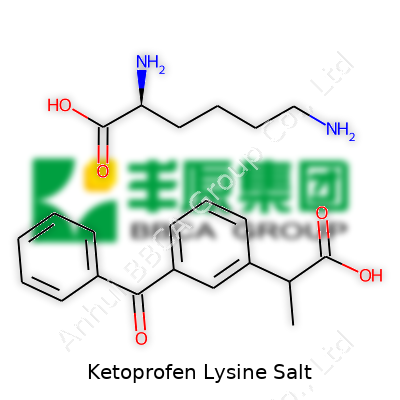
Our teams have watched the journey of ketoprofen lysine salt from its origin as a modified nonsteroidal anti-inflammatory drug to a fixture in pain management protocols worldwide. Back in the 1970s, medical research focused on moving beyond the gastric side effects linked to classic NSAIDs. Scientists proposed the lysine salt form to boost water solubility and speed up absorption. This move directly addressed patient complaints about slow onset and the irritating effects of many acidic drugs on the stomach. Production facilities responded by adapting manufacturing environments for a product that mixed comfortably in both laboratory and industrial settings. Regulatory approvals followed in Europe and elsewhere, solidifying this compound’s reputation long before global harmonization in pharmaceutical manufacturing became today’s standard.
In daily work, factory hands and engineers encounter ketoprofen lysine salt as a white to off-white powder. Unlike its free acid, the lysine salt dissolves well in water, allowing precise control during processing. Pharmaceutical production prefers this form for oral sachets, injectable solutions, and topical formulas. Formulators appreciate the enhanced bioavailability and the opportunity to ease pain faster for end users. This shift isn’t just about smoother marketing—patients often report less stomach discomfort, which aligns with decades of feedback tracked by pharmacists and clinical staff. The lysine salt’s consistent performance means large-volume production can maintain quality with fewer out-of-spec batches.
Close observation of each lot in-house tells us ketoprofen lysine salt’s melting point often falls in the range of 92–98°C, with high hygroscopicity that demands dry room handling. Structural analysis shows a non-crystalline nature under standard drying methods, making it ideal for direct compounding. Over years of monitoring, the molecule’s stability remains strong in neutral and slightly alkaline environments, though exposure to heat above processing thresholds triggers gradual breakdown. Packaging lines run smoothly due to its fine particle size and minimal residue in blending equipment, which reduces downtime for cleaning and enhances yield reliability.
Each drum sent from the facility matches specifications for active pharmaceutical ingredient content, uniform particle size, and low moisture—typically under 0.5%. Finished product assays regularly land between 98–101%. Operators stamp batch labels with manufacturing date, storage temperature limits, and shelf life recommendations based on decades of data. Batch-to-batch consistency keeps confidence high for partners downstream. Quality control relies on validated methods according to pharmacopeias, and in-process control samples give early warnings of any deviation. These routines have become second nature on the floor, shaped by cycles of regulatory inspections and hands-on troubleshooting.
Manufacturing runs rely on a reproducible synthetic route. The process starts with pure ketoprofen, neutralized with pharmaceutical-grade lysine under controlled pH. Salification happens in stainless steel reactors. The reaction’s exothermic nature requires steady cooling and monitoring to prevent impurity formation. The crude salt gets filtered, washed with cold water, and vacuum-dried to achieve the targeted residual solvent limits. Technicians know the signs of off-target crystallization and time the transfer to the dryer closely. Automation of dosing systems and pH controllers keeps the product within tight technical parameters, and process validation rests on destructive and non-destructive batch release tests. Experience shapes production logistics—humidity and temperature control keep the line moving year-round, even in high-output campaigns.
In experimentation for advanced applications, chemists seek ways to graft further modifications. The carboxylic acid of ketoprofen remains open to esterification, and lysine’s amine group allows for alternative salts or co-crystals. While the parent salt form dominates for medical use, teams routinely test novel salts for solubility, bioavailability, and transdermal delivery improvements. Research staff also explore functionalization using carbodiimide chemistry or amide bond formation for drug conjugates. Every innovation cycle tests how much the salt’s advantageous absorption window can be optimized while retaining its established safety profile.
Historically, one might find ketoprofen lysine salt labeled as Ketorolac Lysinate, Lysine ketoprofen, or DL-Lysine Salt of Ketoprofen in domestic and export documentation. Differing country registrations led to a parade of proprietary names, with end products on pharmacy shelves under distinct branding. Manufacturing and regulatory teams track these names to avoid confusion in export documentation. Variations in local language or regulatory requirements sometimes necessitate unique label content, but the fundamental molecule behind the brand remains unchanged from batch to batch.
Plant staff and supervisors embed safety culture in daily routines, reflecting hard-learned lessons from decades in industrial pharmaceutical manufacturing. Air handling systems, dust collectors, and personal protective equipment prevent respiratory exposure to fine powders. Standard operating procedures define safe handling, transfer, and cleaning practices to contain dust and avoid slips or cross-contamination. Environmental controls restrict effluent discharge and airborne emissions under strict local and international codes. Technicians check safety data sheets and reinforce hazard communication at every shift. Recent process upgrades use closed-transfer systems to minimize operator exposure, driven by continuous risk assessment and near-miss reporting.
Most facilities ship ketoprofen lysine salt destined for oral granules, dissolvable powders, and injectables. Hospitals and clinics rely on its rapid onset to provide relief from acute pain, migraines, dysmenorrhea, musculoskeletal inflammation, and sometimes minor postoperative discomfort. Veterinarians use carefully labeled batches for certain animal formulations. Research hospitals explore combinations with other drugs to accelerate recovery in post-surgical protocols. The lysine salt’s utility isn’t limited to large-scale pharma. Small-scale compounding pharmacies and biotechnologists appreciate its rapid dissolution in water-based vehicles, speeding up patient relief and lowering risks of insoluble residues in suspensions.
Scientific partnerships between our R&D department and university consortia track progress on new delivery formats, targeting controlled release, nanoparticle suspensions, and even 3D-printed drug matrices. Collaboration with clinicians fuels innovation to reduce dosing frequency and improve compliance, especially among elderly patients with chronic pain. Successes stem from iterative prototyping and real-world validation. Batch records from these pilot runs cross our desks, giving feedback on bottlenecks or novel stability challenges. In-house labs have also studied salt pairing alternatives that can offer even less gastrointestinal upset or greater tissue targeting. Patent filings reflect years of incremental improvements, backed by data from our own studies and those of our partners worldwide.
Toxicology units dedicate steady resources to ketoprofen lysine salt, especially given patient variability and off-label interest. Data over the years confirm that plasma concentrations peak rapidly, and the adverse effect profile usually mirrors that of older NSAIDs, though with a milder touch on gastric mucosa. Regular chronic exposure studies in rodents and canine models guide safe dosing protocols. Close analysis of leukocyte counts, liver and kidney markers, and reproductive impact help regulators and prescribers set rational guidelines. Preparation teams receive training based on historical accident reports, reinforcing respect for dust exposure and accidental ingestion or eye contact.
Workshops and industry panels highlight persistent demand for fast-acting, stomach-friendly NSAIDs. In-house discussions consider further efforts to combine ketoprofen lysine salt with gastroprotective compounds, explore double-layer tablets, and improve palatability of oral forms. Growing regulatory focus on sustainability and green chemistry shapes new solvent selection and waste reduction strategies. Digital batch record integration streamlines compliance and improves data traceability. Expectations rise for integrating automated in-line monitoring, allowing real-time release and fewer rejected lots. As pain management evolves, ketoprofen lysine salt stands primed for wider global acceptance, and ongoing research ensures manufacturing methods remain aligned with new clinical needs and tighter quality expectations.
Living through shifts in the global pharmaceutical landscape, we’ve seen demand grow steadily for fast-acting, well-tolerated anti-inflammatory solutions. Every year, hospitals, clinics, and pharmacies place new orders, driven by a clear need: effective pain management with fewer stomach troubles than classic options. Our production facility focuses on meeting these needs in the form of Ketoprofen Lysine Salt, a salt form of the better-known ketoprofen. This modification transforms the parent molecule. It gets absorbed more quickly and causes less irritation—a significant edge for both prescribers and patients.
Standard ketoprofen can cause digestive irritation, and some patients turn away from it because of this. The lysine salt version offers a way through this roadblock. The solubility and absorption profile shift, leading to gentler effects on the gut and more rapid arrival of active drug in the system. From what we see, many physicians prefer prescribing it for acute pain episodes following injury, dental procedures, or surgery—where time matters and comfort drives recovery. The more rapid pain relief gets people moving sooner, which has real implications for both health outcomes and healthcare resource use.
In our line, we work with companies specializing in formulations for musculoskeletal and inflammatory conditions. Their feedback always singles out speed of onset and patient tolerance as key factors. The anti-inflammatory power of ketoprofen lysine salt helps simplify flare-ups in osteoarthritis, sprains, or dental pain. One demand we see increasing comes from sports medicine and short-term trauma care, where both the patient and the prescribing doctor want a product that acts fast, clears from the system smoothly, and can be combined with other therapies.
No matter how high efficiency climbs in our reactors, quality always takes priority. Our chemists track impurities down to the smallest percentages. Batch after batch, tests confirm purity before shipment. As a direct manufacturer, we’ve had to adjust to stricter scrutiny and evolving regulatory demands, especially in export markets. Recent years have brought new filings for generic alternatives, so we’ve reinforced our internal protocols to stay ahead of both compliance updates and new pharmacopoeial standards.
The past few years underscored the importance of flexibility in our manufacturing schedule. Supply chain disruptions rattled every industry, but healthcare cannot afford long outages. We keep close ties with lysine and raw material suppliers. Our purchasing managers work overtime when geopolitical issues threaten shipping lines, just to preserve steady flows. Insight from past disruptions pushed us to stock more precursors on-site and to factor in longer lead times for analytical testing and documentation. This firmness in the supply chain gives our partners confidence they can depend on us—whether developing a new pain management product or running a busy hospital pharmacy.
The world’s understanding of pain has evolved. Short-term pain management supports faster, less complicated recoveries. In practice, people demand treatments that work reliably without causing further health problems. Now, oral formulations and injectables containing ketoprofen lysine salt address these expectations for many health situations. Our own experience on the manufacturing floor confirms: if you give people a product that delivers fast, effective relief, with less risk of gastric side effects, physicians will keep coming back to it and patients will trust it.
In manufacturing Ketoprofen Lysine Salt, our role extends beyond technical synthesis and quality assurance. We drill into the details of how this substance interacts with the human body, as its side effects often reflect underlying chemical characteristics and production purities. From raw material sourcing to final formulation, every choice we make matters down the medicinal chain and lands on end-users. Reports about side effects are not just medical statistics—they point to critical junctures where chemistry, human biology, and manufacturing meet.
Gastrointestinal issues top the list for Ketoprofen Lysine Salt users. Many patients report stomach pain, indigestion, or even ulcers. Chemistry drives this profile: being a non-steroidal anti-inflammatory drug, Ketoprofen influences prostaglandin synthesis in the stomach lining. In our plant, screening for chemical stability and impurity levels matters because leftover acids or other contaminants can exacerbate these unwanted reactions. Each lot passes rigorous tests to prevent batches that might unexpectedly heighten gastric irritation.
Skin reactions—itching, rash, or redness—occasionally get traced back to formulation additives or incomplete reactions in production. We track every lot for trace ingredients and test for allergens. Mild allergic phenomena remind us that even micro-parts per million of certain chemistries leave a footprint in sensitive patients. These incidents reinforce strict monitoring and supplier audits on every incoming chemical.
From a production standpoint, renal and hepatic side effects are serious markers. Patients sometimes experience changes in urine, swelling, or altered liver enzymes. Pharmaceutical-grade controls cannot slip: residual solvents or heavy metals can make a difference in the patient’s lab report. Constant upgrades on reactor cleaning, water purification, and waste disposal cut the chance of cross-contamination or byproduct buildup.
Photosensitivity rounds out the class of reported side effects. Patients occasionally get sunburns more easily. This draws our focus to polymorph selection and purity since minor impurities sometimes alter absorption or reactivity under light. Our labs perform forced degradation studies to see what light does to each batch, catching potential risks before the chemicals move to the next stage.
Many side effects show patterns linked directly to process variables. Supporting patients and healthcare providers with batch documentation, impurity profiles, and full traceability calms fears and speeds up investigations when something unexpected happens. Timely feedback loops between pharmacovigilance teams and our floor chemists lead to ongoing process tweaks, not just for compliance but because real cases sharpen our scientific focus.
Each adverse event confirmed in the clinic guides us to review operating conditions, check raw materials, and compare analytical data. Collaborating with regulators and hospitals means updates to specifications happen quickly. Reducing patient risk starts well before shipping; it happens in our dust-collection systems, our air and solvent monitoring, and the attitude shared in our hazard analysis meetings.
As a manufacturer, we care deeply about side effects not just out of necessity, but because our technical craft directly connects to thousands of real people who need relief without new problems. Side effects drive us to invest in smarter testing, finer purification steps, and better responsiveness. At the end of a production shift, knowing our choices might spare someone an ulcer or a rash carries more weight than any output numbers reported.
Pain relief drives a huge part of modern medicine and industry. Every day, we oversee the production of Ketoprofen Lysine Salt, making sure its structure and performance meet the exacting standards expected by hospitals and pharmacists. Our customers, from pharmacists discussing painkillers with patients to formulation scientists designing new tablets, care about more than just what’s in the drum. They care about how this material gets used and whether it helps or harms the people counting on it.
Ketoprofen on its own dissolves slowly and sometimes irritates the gut. Converting it to a lysine salt creates a compound that dissolves much more easily in water. This isn’t just a chemical detail. Quicker solubility means faster absorption, especially important for oral formulations where predictable pain relief can make all the difference. Because we manufacture the salt form ourselves, we monitor every batch for both purity and particle size—two factors that directly affect how tablets or powders break up and release the active pharmaceutical ingredient.
Most users take Ketoprofen Lysine Salt by mouth. Our raw product needs further processing before it reaches the patient: blending, granulation, compression into tablets, or even mixing into sachets for dispersible powders. Pharmacists remind patients that these formulations usually call for a full glass of water. Liquids and dispersible powders also benefit from the salt’s native solubility, dissolving quickly in even ordinary tap water, minimizing risk of stomach upset.
Taking this medication with or after food usually cuts down on the risk of gastric irritation. That advice comes straight from years of medical observation and hundreds of pharmacovigilance reports across the world. Our own quality department has reviewed enough case studies to see clear patterns between food, pH level in the gut, and how well the body tolerates the drug.
Doctors base their dosing instructions on trials and clinical data, not on guesswork. As a chemical manufacturer, we calibrate particle size and purity to reduce batch-to-batch variability. Every kilogram we make gets analyzed to confirm exact ketoprofen and lysine levels. This work may sound routine, but the consistency allows medical professionals to trust that every dose behaves as expected inside a living body.
Patients sometimes break tablets or mix up dosing intervals. Some dissolve powder in coffee or juice, skipping water, which can change absorption rates or cause GI upset. Education goes a long way, but the formulation also needs to forgive human error whenever possible. That’s why our production targets forms that reliably disperse in water and resist degradation under normal storage conditions.
Ketoprofen Lysine Salt isn’t meant to be chewed or crushed, since that can defeat the benefits of careful manufacturing—rapid dispersal, reduced irritation, and controlled release. Clear instructions on packaging, reinforced by pharmacists, prevent common mistakes. Still, no instruction replaces the value of an honest supply chain, where each manufacturing step underpins the next.
We see downstream effects of our chemical quality—adverse event reports, formulation problems, even recall notices—so stakes are high for everyone. Clear dosing recommendations come from both clinical study and the reliable delivery of every gram. The most advanced pain relief chemistry can’t help if the product doesn’t behave as expected outside the factory. Ensuring the right form reaches the right hands in the right way drives every process step inside our doors.
Manufacturing a nonsteroidal anti-inflammatory like ketoprofen lysine salt starts with a clear understanding of both chemistry and end-use. We pay close attention to purity, particle size, and bioavailability to ensure that healthcare professionals and patients receive a reliable medicine. Reliability in production is essential, but patient safety outranks every technical achievement. Questions about using ketoprofen lysine salt during pregnancy come up for good reason—safety cannot be overlooked when two lives are in the equation.
Ketoprofen lysine salt, as a salt form of ketoprofen, works fast and is well-absorbed. Doctors appreciate its quick onset for pain and inflammation. In the manufacturing facility, we stick tightly to pharmacopoeia standards and regulatory controls, but no process in our domain can eliminate the underlying risks that NSAIDs pose to a fetus. The key issue comes from how NSAIDs interact with fetal development. Studies have linked NSAIDs to possible complications including premature closure of the ductus arteriosus (a blood vessel the fetus relies on), especially if used in the later stages of pregnancy.
Despite the effectiveness of ketoprofen lysine salt as an analgesic, current medical guidelines tend to steer pregnant women away from all NSAIDs after about week 20, unless a doctor specifically decides otherwise. Health authorities and medical councils across the world echo the warning—NSAIDs during late pregnancy can threaten healthy fetal development.
As a manufacturer, we see our job going beyond just reliable production. We supply healthcare providers and pharmacists with technical bulletins that spotlight contraindications and safety warnings. Every batch released onto the market includes up-to-date risk statements. Nitpicking each batch for compliance and pushing updated documentation lets us support medical professionals with real, actionable information. That is especially important around drugs that affect exposed populations like pregnant women.
There is, at times, discussion about whether certain NSAID salts are less risky thanks to faster absorption and potentially lower systemic exposure. Reality does not yet support changing the known risk profile for ketoprofen lysine salt in pregnancy. The scientific data keeps pointing to the pharmacological activity rather than the salt form as the determinant risk factor.
The best tools against misuse are education and clear labeling. Caregivers, pharmacists, and expecting mothers should receive all information they need to make the right choices, starting at the packaging level. Our teams make sure every box of ketoprofen lysine salt stresses the risks during pregnancy, and we support training for healthcare partners who provide real-world advice. Manufacturing might begin with powder and solvent, but patient safety ends with collaboration across the supply chain.
For pregnant women, medical advice always takes priority. If pain relief is truly necessary, doctors often consider other medications with better-documented safety profiles during pregnancy. Ketoprofen lysine salt remains a modern, potent option for pain, but as manufacturers, we recognize that some groups, like expectant mothers, require extra caution. Respecting that boundary builds patient trust and protects our reputation in every batch we produce.
Working at the source, we do more than produce fine chemicals — we study their behavior from the inside out. With Ketoprofen Lysine Salt, people often ask whether this popular anti-inflammatory ingredient clashes with other medications. The answer deserves straight talk rooted in hands-on understanding.
Over years of synthesizing Ketoprofen Lysine Salt and collaborating with hospital partners, we see the difference minor formulation tweaks can make. Global guidelines classify Ketoprofen as a non-steroidal anti-inflammatory (NSAID), processed by the body’s liver enzymes, especially CYP2C9 and CYP3A4. Every clinician knows how enzyme activity can shift when other drugs compete for the same metabolic machinery.
Prescribers sometimes overlook common drugs already in a patient’s routine. Say a patient starts on warfarin or similar anticoagulants while taking Ketoprofen Lysine Salt. This can increase the risk of gastric bleeding, because both compounds can disrupt blood clotting—one by mechanical means, the other by changing the gut lining’s sensitivity. Every batch we produce comes with the knowledge that one overlooked interaction can end with someone’s hospital trip.
Similar questions come up with diuretics and ACE inhibitors. NSAIDs can raise blood pressure or worsen kidney function when combined with these medications. Having seen procurement requests jump for different excipient grades, it’s no surprise—careful clinicians keep interactions in mind. Years of batch records remind us that adjustment in composition or administration timing helps, but not all doctors inquire about each new medication their patient adds.
Studies confirm direct links: NSAIDs like Ketoprofen Lysine Salt can raise serum lithium levels, slow down excretion of methotrexate, and interfere with antihypertensives' effectiveness. Our technical team rarely has a meeting without a pharmacologist reminding us that mixing NSAIDs and corticosteroids ramps up ulcer risk. No theory, just data shared by pharmacovigilance partners and post-market reporting.
In our work, process controls safeguard purity and help reduce contaminants that could worsen interactions. We monitor every batch for trace metals and organic solvents, knowing that impurities—no matter how minor—can skew blood levels when someone takes two or more drugs at once. It only takes one nonconforming lot to remind us the stakes stand high, so we have zero tolerance for variance in what hits the market.
Doctors and pharmacists still need real-time support. We maintain a feedback channel with healthcare teams, updating them when new research points to heightened risks. Our regulatory submissions feature not just formula data but also real answers for frequently asked questions on drug interactions.
No amount of labeling beats the impact of patient education. Open conversations between prescribers and patients about all medications prevent the worst outcomes. As a manufacturer, we supply the technical foundation, but clinical wisdom fills the rest of the picture.
In day-to-day production, our lived experience with chemical properties, purity controls, and collaboration with health professionals reminds us that Ketoprofen Lysine Salt can interact with other drugs, sometimes with serious outcomes. Our job extends past the reactor vessel — we hold responsibility, from raw material selection through guidance shared in real-world practice. We deliver not just chemicals, but crucial information that supports safer, wiser healthcare decisions for all involved.