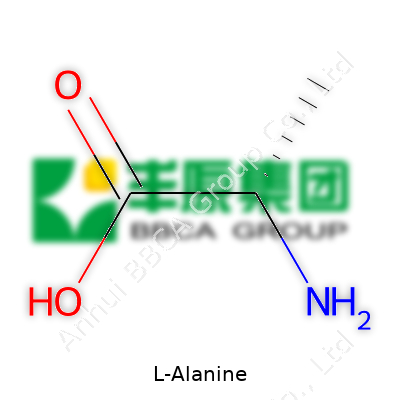
The journey of L-Alanine stretches back to early amino acid research in the nineteenth century. Friedrich Tiede isolated it as part of a broader effort to decode proteins, following the isolation of other amino acids like glycine and leucine. Synthetic chemistry soon picked up from nature’s clues, as researchers modeled lab methods to access pure forms beyond protein hydrolysis. In our experience, every step forward in purification, synthesis, and testing turned a basic discovery into a reliable ingredient. The movement from academic curiosity to industry-scale production reflects not just scientific progress but also discipline in scaling yield, minimizing byproducts, and making each batch dependable for downstream use. No shortcuts—every innovation shapes today’s products and tomorrow’s opportunities.
L-Alanine stands as a small, simple, and essential alpha amino acid. As we see in our plants, it plays crucial roles in both metabolic cycles and as a starting material for derivatives. In our business, L-Alanine rarely sits on the shelf unclaimed. It leaves our reactors destined for a range of applications: nutritional supplements benefit from its safety and bioavailability, pharmaceutical development leans on its stability, and food formulators appreciate its flavor-enhancing and textural contributions. Each shipment represents a chain of trust: from careful fermentation or synthesis decisions, thorough QC, and transparent labeling, all the way to customer hands.
By nature, L-Alanine forms colorless to white crystalline solids or powders, stable at room temperature and under a variety of storage conditions. As a zwitterionic molecule, its solubility in water supports both formulation and biochemical research. We’ve put every batch through rigorous melting point analysis, solubility checks, and chromatographic purity assessments. In neutral or slightly acidic water, it never surprises us. Analytical HPLC and polarimetry give us the confidence that each lot matches the enantiomeric purity needed for clinical and food uses alike. In a process plant, pH, clarity, and particle size aren’t just academic notes. They affect everything from how safely the reactor runs to how smoothly the final product blends, dispenses, and performs at customer sites.
Decades of experience teach that no two application areas want to see the same certificate of analysis, but everyone demands clarity. That pushes us to standardize amino acid assays, keep moisture control tight, and double down on the tests for heavy metals, microbial residues, and other possible cross-contaminants. Optical rotation stays for confirming chiral consistency. Allergen statements aren’t a regulatory burden; they’re a way to reassure customers about product origin, risk of cross-contact, and dietary compliance. Every barrel, drum, or package gets batch numbers, shelf-life, and source method details. This isn’t red tape—it’s a handshake of trust.
Within our facilities, production routes have shifted and sharpened over the years. Traditional approaches using acid or enzymatic hydrolysis of proteins now share space with fermentation and chemical synthesis. Fermentation—leveraging strains of Escherichia coli or Corynebacterium—brings advantages in scale, byproduct minimization, and compliance with food or pharma standards. Still, chemical routes remain valuable for specific demands, especially in terms of trace impurity elimination or fine control over isotope labeling. Every method requires discipline—from pH control in fermenters, to gradient optimization in purification, to solvent recovery. Our teams keep process water and energy usage front-of-mind through every production cycle. Feedback from every QC release reflects both hard-won expertise and ongoing dialogue with our partners pushing for greener, safer chemistries.
L-Alanine’s methyl side chain keeps it straightforward in reactions, but that simplicity allows a surprising variety of modifications once you start coupling, protecting, or derivatizing it. Peptide synthesis relies on its dependable reactivity, whether in Fmoc or Boc protocols. Reductive amination or amidation opens new doors in drug research, glycine conversion, and isotope labeling. We’ve seen demand spike for N- and C-protected forms as both chemical building blocks and analytical standards. Researchers rely on our high-purity standards for their own downstream syntheses, not just our off-the-shelf product. Process knowledge here comes not just from literature, but from days spent troubleshooting reactions, minimizing racemization, and finding greener solvents for established transformations.
Our labeling always covers the recognized alternatives for L-Alanine, ranging from its systematic name (2-aminopropanoic acid) to more common trade forms in supplement and food markets. We make sure customers understand that “L” isn’t just a prefix; it means physiological compatibility. Regardless of what’s printed—L-α-alanine, Ala, or CAS 56-41-7—the confidence lies in consistency, not clever branding.
Every chemical manufacturer’s story includes a few mistakes, but safety culture stops repeat problems. Over years scaling up L-Alanine production, we built systems around dust control, spill cleanup, and respiratory protections, even when working with food or pharma gradings meant low hazard levels. Handling crystalline powders always brings questions of airborne sensitizers, but robust hygiene and environmental controls keep both product and people protected. Our teams follow guidelines beyond minimum requirements, learning from each published incident in chemical operations worldwide. Waste management follows local and international guidance, minimizing impact in real terms, not just on paper forms. We train every operator and technician on the risks, not just the compliance points.
Demand for L-Alanine spans continents and market sectors. Supplement formulators want both non-GMO and vegan assurances. Food technologists focus on its role as a taste enhancer or flavoring agent, finding ways to round out profiles or mask off-notes in protein-rich products. Pharmaceutical clients push for injectable standards, making sterility and low endotoxin critical benchmarks. In animal nutrition, careful supplementation can support growth and food conversion. We’ve responded to each new requirement with tailored grades and transparent backtracking, not just product churn. Custom blends or co-crystals have sometimes unlocked new uses no handbook could anticipate.
Each year, our R&D teams pick up dozens of challenging requests—everything from minor impurity profiles to biobased process alternatives, analytical references for stable isotopes, or new delivery formats like microencapsulated granules. We’ve seen industry trends racing towards greener methods, targeting single-use plastics elimination, or integrating continuous processing. Feedback from both regulators and direct customers shapes our focus. Collaborative research with universities and pharma companies has sparked off new high-throughput screens, improved enantiomeric separation steps, and more robust testing for trace residuals. Progress does not come from comfort. It comes from questioning every step of the process and never settling for yesterday’s best practices.
Workplace and consumer safety depend on knowing L-Alanine’s toxicology profile down to the fine details. Decades of nutritional and physiological studies have shown it to be safe at levels typical in foods, supplements, and parenteral nutrition. We point to both animal studies and broad human experience for support; still, we invest in regular review of research on allergenicity, environmental fate, and any rare adverse reports. Across all grades, we keep tight controls on contaminants, as safety hinges more on what rides along than the main ingredient itself. Even for “safe” products, vigilance remains the best defense.
Product lines cannot afford complacency. Interest grows in using L-Alanine not just as a direct ingredient, but also as a platform for smart materials, new peptides, or next-generation nutritional blends designed around individual needs. Green chemistry keeps driving us toward fermentation and more sustainable downstream processing. Pharma discovery moves towards more complex peptides, pushing for specialty derivatives and new coupling agents. Nutritional science increasingly turns to amino acid profiles to solve dietary imbalances in emerging populations. We keep building for these challenges—improving yield, purity, and traceability every cycle. Our perspective doesn’t just rest on yesterday’s demand, but stays built around open channels with partners who are willing to question, test, and innovate with us.
Every day on the production floor, we handle amino acids by the ton, but L-Alanine stands out. Many outside chemical manufacturing imagine amino acids just belong in sports nutrition or as food supplements. From direct experience, there’s a much broader story to tell. L-Alanine matters because of its simplicity, its clear biochemistry, and its impact across multiple sectors—something you wouldn’t necessarily guess from its gentle, sweet taste or its white crystalline powder.
In the body, L-Alanine serves as a crucial bridge for glucose—the main fuel for muscles and the brain. Our process keeps this in focus: we track purity, traceability, and contaminant controls, since users—from researchers to pharmaceutical formulators—depend on those standards. Errors at our level can mean costly setbacks downstream, so the stakes remain real no matter how routine the batch may seem.
L-Alanine is popular in clinical nutrition, not by accident but by clear metabolic logic. It's frequently used in intravenous nutrition for patients who can’t eat. It helps support tissue growth and muscle repair, making it useful in recovery protocols in hospitals. Year after year, we hear from medical partners about how precise sourcing saves them time on further testing, giving doctors greater confidence in patient care. In our line, that's a direct chain from bulk chemical to end benefit.
L-Alanine’s ability to help regulate blood sugar gives it added importance for anyone developing nutritional support formulas. For diabetics and those at risk of hypoglycemia, solutions designed around safe and reliable amino acid metabolism can tip the balance in patient management. We've seen how errors in process can set back pharmaceutical timelines by months—so our team views batch-to-batch consistency as non-negotiable, not just a cost line item.
Supplement brands use L-Alanine in protein powders and energy support products because the taste is dependable and production is straightforward if care is taken to keep moisture low. But outside of human consumption, L-Alanine still has a big role. Laboratories depend on ready-to-use amino acids for research tools, like buffer agents or cell culture media. We’ve learned over time that even tiny inconsistencies make a difference at scale. That’s why process audits matter more than any marketing claim.
Animal feed producers also request L-Alanine for high-efficiency feed blends, boosting growth rates and health for livestock. Their needs highlight a fragile link: any downgrade in amino acid stability or purity can result in unpredictable performance and waste. Our engineers collaborate with feed producers to make sure shelf life and solubility hit targets reliably, because even a small drop in active content can raise costs across a whole supply chain.
L-Alanine’s production pulls its share of energy and water, and oversight from our environmental team ensures we don't overlook that impact. Waste minimization isn’t just about compliance; over the years, it’s meant hard choices in sourcing raw intermediates and investing in better purification. Sustainability matters as much for bulk aminos as it does for everyday consumer goods. Customers now ask tough questions about process transparency, traceability, and responsible sourcing, and it's our responsibility to be ready with real answers, not buzzwords.
Every day in the facility, teams handle L-Alanine with attention. As a naturally occurring amino acid, L-Alanine turns up in everyday food—meat, dairy, grains, and even some vegetables. Eating a normal diet already introduces measurable amounts of L-Alanine into the body, and this matches what nutrition science continues to confirm: L-Alanine is part of what keeps metabolism running. For someone in manufacturing, seeing raw L-Alanine sorted, processed, and checked, it’s clear this isn’t an unfamiliar compound the body won’t recognize.
Producing a food-grade or supplement-grade L-Alanine involves more than just mixing materials. Monitoring for contaminants—heavy metals, residual solvents, and microbial activity—forms a big part of any reputable process. Regulatory rules, including those set by international food safety agencies, make sure every batch matches purity benchmarks. Random sampling, batch-test records, and documented results support the fact that properly manufactured L-Alanine aligns with recognized safety thresholds.
From the manufacturer's perspective, the product doesn’t leave the plant unless it meets these requirements. Food and supplement companies depend on this consistency and stability, especially since L-Alanine often finds its way into energy drinks, protein mixes, and even hospital nutrition formulas.
The human body can produce L-Alanine from other sources—so it won’t treat it as an unknown or harmful substance. Research shows that moderate supplemental use matches what the liver and muscles already handle. In fact, any excess usually gets metabolized efficiently, unless someone faces specific medical conditions that compromise amino acid processing. From operators to quality control chemists, there’s general agreement that L-Alanine in reasonable doses falls within a safe range for most healthy adults.
What sometimes surprises supplement users is how much is present in regular meals. A balanced meal can introduce several grams without any apparent risk. Most studies look at higher doses only in specific therapeutic settings, and even those report low rates of adverse effects.
No process is perfect, and discussions about long-term safety do spark conversations in production meetings. Over-supplementation—or using L-Alanine at levels far beyond dietary amounts—brings its own cautions. The kidneys, for instance, process amino acids, so anyone with kidney disorders should consult a healthcare professional before taking extra L-Alanine. Within the chemical manufacturing world, clear labeling and transparent documentation allow downstream users—health brands, nutritionists, researchers—to make their own informed decisions and avoid misuse.
For bulk buyers and product formulators, the important questions should revolve around traceability, confirmed testing, and full disclosure. The burden falls on manufacturers to offer test reports, batch histories, and compliance certifications on request. Some buyers also ask about allergen risks or potential bioaccumulation. Independent third-party lab results help address these types of questions so nobody makes guesses about safety.
Manufacturers watch food trend shifts and new research. Transparency about ingredient sourcing, process quality, and scientific evidence gives everyone—whether chemist or end consumer—a better foundation. L-Alanine, in the dosages seen in standard supplements and daily diets, maintains its reputation for safety, provided manufacturing remains rigorous and communication stays open. As technology allows purer materials and better tracking, the safety bar keeps rising, much to the benefit of all who depend on these ingredients.
L-Alanine often draws attention for its role in human nutrition, fermentation, and industrial processes. Our team works with it daily, and we know the importance of accuracy in dosing not just for performance, but also for safety and consistency. We’ve spent years both observing trends and working closely with end-users—food processors, supplement formulators, and pharma partners—who count on disciplined practices.
Looking at nutrition, peer-reviewed studies show L-Alanine appears naturally in many proteins and finds its way into dietary supplements promoting muscle recovery or endurance. Clinical trials and sports nutrition literature often reference intakes between 1.5 grams and 3 grams per day for adults. Amino acids are best considered in context, and L-Alanine’s routine use seldom exceeds 4 grams per day in authorized sports products or general nutrition formulations. Athletes experimenting beyond this rarely report added benefits and excess usually exits the body unused.
In fermentation, our customers regularly dose L-Alanine as a carbon and nitrogen source. Precise requirements follow microorganism strain and production goals, but typical additions hover between 0.5% and 2% of the substrate by weight. Changes in pH, temperature, and feedstock make a huge difference. Our technical teams notice that higher concentrations can sometimes suppress yield instead of boosting it, so hands-on pilot trials remain essential. We advise formulation scientists to adjust additions in small increments and always validate on a small scale first.
Food and supplement producers always face regulatory scrutiny, and our QA department works with the latest guidance from global agencies. The FDA classifies L-Alanine as GRAS—it’s generally recognized as safe for use in food—but that isn’t a green light for unlimited add-back. The European Food Safety Authority points to existing intakes in conventional nutrition and places similar boundaries on new applications. Too much L-Alanine, especially in purified form, brings risk of digestive discomfort.
Our QC records show complaints spike when finished products carry more than 4 grams per serving. Most negative feedback relates to taste, with excessive amino acids leading to off-flavors or aftertaste. At scale, these things matter—one batch bottleneck or recall can crater margins, so we pay close attention to aggregate amino acid loads across blended formulations.
All customers want to optimize cost and effect. We urge buyers and technical leads to base inclusion rates on peer-reviewed science, established food standards, and actual trial data. Our best partners share their batch records, trust the technical team with granular feedback, and invest the time to track end-user experience. Staying well within established dosing limits proves more reliable than pushing for theoretical gains by overshooting the mark.
We see the best success with customers who embrace steady, conservative adjustments and watch customer feedback closely. Optimizing L-Alanine use means finding the sweet spot, not the peak. As manufacturers, we invest in R&D, robust testing, and clear technical communication to ensure everyone down the line—from food scientist to consumer—gains confidence in their chosen dosage. L-Alanine doesn’t reward short-cuts or over-ambition. It rewards care, logic, and real-world observation.
Supplements often grab attention for their quick-fix image, and L-Alanine landed in that spotlight thanks to its connection with muscle recovery and endurance. For the folks synthesizing this amino acid every day, the product looks straightforward: a white crystalline powder, easy to blend into capsules or shakes.
As real producers, we see the journey from raw material to finished product. Our batches go through regular purity checks—chromatography, spectrometry, and microbial screenings. We follow standards that make the finished L-Alanine more than just a white powder; our teams focus on traceability and clean processing.
People ask about side effects, and it’s worth cutting through the generic “well-tolerated” language. We rarely hear about adverse issues in healthy adults given standard doses. The body naturally makes L-Alanine, so supplements just increase an existing amino acid pool. But more does not always mean better.
Doses far above nutritional need could nudge metabolic balance in odd directions. Too much can put stress on the kidneys, especially in folks with compromised function. Kidneys must break down and clear excess amino acids, which leads to more work for an already strained system. There’s also the chance of interacting with other amino acids and competing for absorption—this sometimes shows up as mild digestive upset or changes in energy levels.
We see that people with rare metabolic issues, like alanine transaminase deficiency, should steer clear of high-dose alanine products. This isn’t a warning for the majority, but it matters for the small number who face these problems. High intake also holds risks for those dealing with pre-existing liver or kidney disease. We don’t see these scenarios often from the production side, but medical literature and customer feedback remind us they exist.
We build checks into our manufacturing so every batch lines up with what science knows to be safe. There’s always more pressure to deliver “stronger” or “performance-grade” blends, but we stick to known quantities because overtuning amino acid blends is a recipe for trouble. Most side effects come from ignoring this simple principle.
Transparency helps. We mark every product clearly and provide batch-level data for those requesting it. Healthcare professionals and nutritionists use this information to guide their recommendations and adjust for sensitive groups. Supplements are never a substitute for a balanced diet or proper medical oversight, and we say this openly.
Consumers reach out asking for our take on internet trends and celebrity-endorsed stacks. We won’t jump into marketing bandwagons. Our direct experience says people do best with moderation, sound science, and products made to high standards—not just flashy promises. Clear labeling and open communication serve everyone better than empty claims.
We keep quality and safety at center stage. Those dedicated to lifting heavier, running longer, or simply supporting daily nutrition often see improvement with well-made L-Alanine—side effects stay rare when used sensibly. Honest manufacturing adds up to safer supplements and fewer surprises for end users.
Our daily work involves turning fundamental raw materials into pure L-Alanine powder, shipped to sports nutrition brands and research labs. We see the ingredient up close—scrutinizing texture, solubility, and purity with every batch. The more we interact with customers committed to physical performance, the more questions come up about L-Alanine’s value for athletes.
L-Alanine stands out among amino acids because of its connection to glucose production. Muscles under stress naturally release their own stores of alanine, which then gets shuttled to the liver and converted into glucose through the alanine cycle. This pathway helps maintain blood sugar during long workouts. Research shows that after extended exercise, blood concentrations of alanine drop, suggesting real demand from working muscles.
Sports companies ask about L-Alanine because they’ve noticed real athlete curiosity about next-generation amino acids. Many endurance-oriented brands have added L-Alanine to drink mixes for cyclists and runners. Direct customer feedback often centers not on instant performance boosts but on sustained energy and faster post-exercise recovery. Some teams use it alongside other amino acids, looking to buffer fatigue and preserve muscle strength during heavy training cycles.
Peer-reviewed studies on L-Alanine supplementation and actual exercise performance remain limited compared to more famous amino acids like BCAAs or beta-alanine. Some lab reports suggest that extra alanine contributes to better glucose balance during exercise. At the manufacturing level, repeat business from performance nutrition brands suggests that regular end-users perceive a benefit, especially for endurance sports.
No single ingredient transforms athletic ability in isolation. Turnover of energy substrates is complex. People who add L-Alanine to their nutrition routine often use it as one part of a detailed supplementation plan alongside carbohydrates, electrolytes, and other amino acids.
From chemical synthesis through refining and testing, we control for impurities that might undermine product quality. High-purity L-Alanine dissolves quickly and does not carry unpleasant flavors or aftertastes found in some other amino acids. This makes it appealing for formulation in beverage mixes—important for athletes who want nutrient delivery that’s palatable and quick-absorbing.
Athletes, teams, and brands ask us what sets our L-Alanine apart. Beyond technical details, our answer is this: clean production, verified analysis, and a commitment never to make exaggerated claims about performance. We encourage customers to follow emerging studies and share feedback so formulations reflect both new evidence and real-world experience.
Athletic performance depends on the right training, rest, and nutrition. L-Alanine does its job best as a supporting player—contributing to energy balance and muscle preservation, especially during prolonged or high-intensity activity. As more research emerges, direct collaboration between manufacturers and nutrition professionals remains key for any ingredient’s responsible use.