L-Lysine production traces its roots to the fermentation breakthroughs of the late 1950s. Before this time, L-Lysine remained a rare commodity, mostly isolated from protein hydrolysates in small amounts. Demand from feed, food, and pharma drove biotechnological research to seek scalable, affordable methods. We invested heavily after realizing fermentation with Corynebacterium glutamicum could deliver L-Lysine at previously unattainable yields. As industry partners refined microbial strains and fermentation controls, factory output rose steadily to meet expanding global feed demands. At the same time, downstream processing needed major updates, especially with salts like L-Lysine acetate—in the early days, strict control over purity, residual solvents, and moisture content proved tricky and required constant attention on the chemical line. We navigated these hurdles by designing tailored crystallization and filtration trains, always seeking to maintain high isomeric purity and product recovery.
L-Lysine acetate has become favored in formulations where hydrochloride brings unwanted chloride load or pH changes. Our acetate salt, made from pure fermented L-Lysine and high-purity acetic acid, delivers L-Lysine in a more neutral salt form. The product supports requirements in parenteral nutrition, oral supplements, and sensitive pharmaceutical blends. End users seek tight batch-to-batch consistency, which we maintain by adhering closely to validated process parameters and analytical controls. Feedback from both downstream formulators and quality teams keeps us vigilant about residual organic impurities, moisture, and trace metals—areas long neglected by traders or secondary packagers.
L-Lysine acetate appears as a white or nearly white crystalline powder. High-resolution microscopy shows uniformity once processes stabilize, but variable cooling rates can introduce clumping or needle habits—operators must know how to spot these quickly. The powder absorbs moisture, prompting strict environmental controls during packing. On the chemical front, L-Lysine acetate carries both a free amino group and the salt of the side chain, leading to a mildly acidic pH in solution (usually between 7.5–8.5, depending on exact water content and batch). Water solubility comes in above 500 g/L at room temperature, so dissolution is rarely an issue—if it occurs, it flags upstream crystallization or the presence of non-product fines.
We standardize all batches around L-Lysine content (calculated on an anhydrous basis), with label claims typically ranging above 78% by mass. Moisture specification is kept below 5.0%, as higher levels risk caking and degradation. Acetate content sits around 21–23%, and absence of heavy metals, microbial burden, and residual solvents forms the critical technical backbone. Every shipping label captures both chemical and microbial testing, not as regulatory box-checking, but as a demonstration of real production accountability. Instances where incoming QC flags a deviation prompt an audit and usually spur ongoing process improvements. This cycle—data-driven, problem-solving, and always transparent—separates manufacturing from simple commercial repackaging.
In plant practice, production begins in the fermentation hall, where pure L-Lysine builds up over a multi-day microbial fermentation. Downstream, we blend recovered L-Lysine broth with filtered food-grade acetic acid. Our chemists monitor both pH and temperature closely, since over-acidification can cause unwanted by-products or even salt out some impurities. After the neutralization step, the solution undergoes repeated crystallization, separating out L-Lysine acetate from mother liquor, which we recycle for solvent recovery. Every filtration and centrifugation cycle refines product purity, with operators visually inspecting slurry texture—a skill passed down through thorough training and experience on the line. The dried powder passes through a final sieving step before packaging in nitrogen-flushed drums to minimize long-term hydrolysis.
In synthesis, L-Lysine acetate gets involved mainly in amide coupling, peptide extension, or esterification, especially for specialty APIs and food-active peptides. Users appreciate its free base form in solution, offering a useful handle for further derivatization without introducing extra chloride or sulfate to finished compounds. In our plant, minor tweaks in the salt-formation phase let us offer L-Lysine acetate with tailored ratios when customers request unusual stoichiometry for a specific reaction stream. Handling solutions with high acetate concentration does require careful corrosion monitoring—acetic acid’s effect on valves and tanks shortens equipment life if we don’t rotate or passivate vessels accordingly.
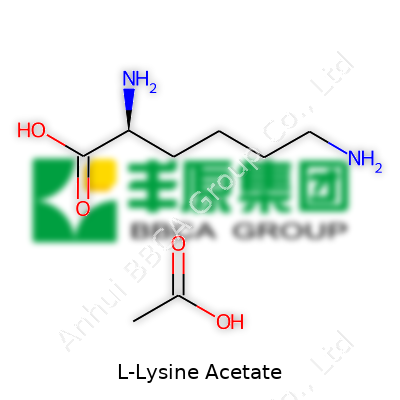
Across decades in this business, we have seen L-Lysine acetate labeled as lysine monoacetate, lysine ethanoate, and 2,6-diaminohexanoic acid acetate. Clients from pharma sometimes use European Pharmacopeia monograph terms, while supplement makers go by CAS numbers or food codex descriptions. For us, clarity means tracking synonyms across label, analysis certificate, bill of lading, and even the outer drum—the wrong term can trigger regulatory delays or customer confusion. Communication with partners, especially in international shipping, depends on knowing these nuances and speaking the “language” of every customer, not just relying on internal jargon.
As a core raw material in both food and pharmaceutical routes, L-Lysine acetate must pass not only chemical specification but microbial, allergen, and even viral screening. In our facility, we update HACCP planning annually, running risk assessments for cross-contamination, traceability, and even intentional adulteration scenarios. We train all new staff in PPE use and bulk powder handling protocols; chronic skin or inhalation exposures rarely pose real risk at normal levels, but spill clean-up and air monitoring remain on the routine checklist due to potential irritation in sensitive individuals. We support our claims with full traceability from raw acetic acid tank to finished drum, and spot-audit third-party analyses to verify compliance. Our long-haul logistics chain implements double-seal security, frequent temperature checks, and requires documentation at every transfer, discouraging substitution and counterfeiting. Recurring audits from major multinational partners keep us fighting complacency, and we view these as opportunities to improve, not mere regulatory burdens.
Most of our output serves nutrition, with application in intravenous solutions, oral supplements, and animal feed. In parenteral nutrition, purity and pyrogen levels dominate discussion. Feed customers look at dusting loss, bulk density, and anti-caking systems, pushing us to engineer flow properties just as much as chemistry. Specialty pharma routes demand custom particle sizing or finer pH control, which we support using both in-process sampling and finished-goods analytics. Research users request L-Lysine acetate for diagnostic enzyme assays, protein stabilization, and as a precursor for synthetic amino acid analogs. Each application brings new control points—issues like batch homogeneity, extractable impurities, and even residual plasticizers from older manufacturing lines have driven steady process changes year by year.
Continuous innovation drives real cost and quality gains, not just for marketing claims but to solve production challenges before they become customer complaints. Our R&D teams have improved microbial strains for higher yield and reduced by-product levels—for instance, suppressing unwanted ornithine through targeted gene-editing. We’ve piloted antifoaming polymers in fermenters, drastically cutting contamination downtime. On the downstream front, teams have developed real-time NIR analytics for moisture content, eliminating old-fashioned oven-drying steps and giving rapid, precise data at every shift. Customer innovation also informs our product line—regular feedback on solubility bottlenecks, allergen content, or heavy metal requirements filters back through our technical groups, closing the gap between lab discovery and industrial application.
Toxicological assessment sits at the top of our material stewardship obligations. Preclinical studies, including those orchestrated by regulatory authorities, show L-Lysine acetate as well-tolerated at levels several orders above daily requirements. Occasional reports of gastrointestinal effects at high doses arise, but no chronic toxicity surfaces below repletion thresholds. For manufacturing teams, attention focuses on airborne dust or accidental large spills; real-world monitoring data from line workers and logistics staff demonstrate that short-term acute exposure stays below occupational limits with proper ventilation and handling. We continue to monitor new literature and regulatory advisories, updating internal thresholds and worker education programs accordingly.
Demand for L-Lysine acetate continues to rise as food fortification, plant-based protein, and biopharmaceuticals expand their reach. Regulatory tightening in every major market deepens requirements for data, transparency, and sustainable practice—trends we match by investing in energy efficiency across fermentation, heat capture from crystallization, and green chemistry in downstream processing. Customers now challenge us not just on price or technical specs, but on carbon footprint, water usage, and even the source of acetic acid, favoring biobased or circular alternatives. We see the need to develop grades with custom solubility or impurity profiles, driven by the next wave of personalized nutrition and functional food. Our technical team pilots next-generation fermentation strains, aiming for both higher yields and lower by-product streams. As biomanufacturing scales, from food to pharma applications, investment in safety, traceability, and regulatory engagement only increases—a challenge manufacturers must embrace if L-Lysine acetate is to meet rising global quality standards without losing cost-competitiveness or customer trust.
L-Lysine acetate might not grab headlines, but on our factory floor, this ingredient gets a lot of attention. We see the questions that come in, asking where it fits or what value it brings. As the team that handles production from raw lysine fermentation to final quality checks, there’s no mystery about how this compound has earned its place.
L-Lysine acetate supports the amino acid needs of livestock, aquaculture, and specialty food industries. Feed producers focus on keeping animals healthy and productive, since lysine stands as one of the key limiting amino acids in animal nutrition. Formulators depend on reliable sources that mix well and deliver predictable results. Feed manufacturers want a form that dissolves easily and stays stable during blending, especially in humid regions or where shelf life plays a big role. L-Lysine acetate answers that need. Many years of production have shown that it resists clumping, flows smoothly, and holds up against the typical abuse of shipping and storage.
Beyond animal feed, L-Lysine acetate lands on the ingredient lists of dietary supplements, functional foods, and clinical nutrition products. Lysine itself helps support protein synthesis and tissue growth. Acetate salt often gets the call because it dissolves quickly and has a milder taste than some other versions. We’ve watched the demand pick up from food companies looking for amino acid sources that work for specialized diets—whether focused on sports, recovery, or general health. Infant formula and medical blends sometimes specify this form because of its ease of mixing and reliable amino acid content. From nutrition bars to ready-to-drink shakes, manufacturers ask for a lysine source that holds up through pasteurization, storage, and shipping, without causing stability problems in their formulas.
Research groups and pharmaceutical companies choose L-Lysine acetate as a key excipient or active ingredient. Peptide synthesis and cell culture applications often specify it for its purity and consistent performance. Labs appreciate the way it blends into buffers and supports cell lines without introducing unnecessary byproducts. Our production teams conduct strict microbial and impurity checks, helping customers avoid unexpected contamination or variability from batch to batch.
Rising cost pressure keeps everyone on their toes. Customers ask us about supply chain security and want tighter control over traceability. Production isn’t just about making a pure product; it’s about reducing energy, managing wastewater, and keeping byproduct recovery on track. For lysine acetate, we’ve invested in closed-loop fermentation and solvent recovery systems to stay ahead of environmental standards and keep costs reasonable.
Sustainability plays a bigger part in every decision. Animal producers and food companies look for partners that support responsible sourcing and waste reduction. We’re always looking for ways to improve water usage in fermentation, energy recovery from steam, and options for spent biomass. Building long-term relationships with animal nutritionists, food technologists, and downstream partners lets us spot problems early and keep our material moving forward.
Every shipment of L-lysine acetate reflects hundreds of hours spent refining process conditions, maintaining rigorous quality checks, and responding to customer feedback. Real production floors face tight deadlines and shifting specs. Decisions about plant investment, purification steps, and packaging affect how this compound performs in the field. The honest reality is that a good manufacturer tightens feedback loops, adapts to the shifting needs of nutrition and health industries, and keeps safety, reliability, and sustainability squarely in focus.
The talk around L-Lysine Acetate’s safety for consumption reflects a core question anyone in production faces daily: can you stand behind what’s coming out of the reactor? In my role overseeing batches from raw materials to final powder, nothing moves forward if there’s a shadow of uncertainty about the finished product’s safety. Most know L-Lysine as an essential amino acid, but the story of acetate as a stabilizing salt gets lost in industry lingo. L-Lysine Acetate isn’t whipped up in isolation; it’s the result of processing practices subjected to food-grade scrutiny and multi-step purification.
Manufacturing this compound means investing in raw source quality, process water standards, filtration, and crystallization far above what’s demanded in less-regulated industries. Every batch carries a record of quality control, from absence of toxic impurities and heavy metals to microbial load within permissible limits, matching standards set by food safety agencies. This isn’t an empty promise—auditors turn up unannounced, and finished batches face random retests. Non-conforming product never leaves the plant.
Those of us at the bench and packaging lines see regulatory shifts firsthand. Food safety authorities have cleared L-Lysine Acetate as a nutritional supplement in various applications. This clearance follows toxicological studies and real-world datasets tracking reported side effects, daily intakes, and populations at risk. Facilities are required to keep up with evolving purity benchmarks and reporting duties, so changes in permitted levels or new data drive process adjustments. If reviewers sound the alarm over an emerging risk, production adapts—sometimes at significant cost.
In the real world, quality matters more than ever, given the global supply chain’s vulnerability. Counterfeit or adulterated batches surface now and then outside certified sources. We respond through unique batch marking, traceable supply chain documents, and rapid removal of flagged product lots. Trust grows not just from lab tests but from openness on each container’s journey from reactor to consumer shelf.
Those unfamiliar with manufacturing often overlook the difference between a food-grade product and technical or feed-grade materials. Process streams reach a much higher purification level for consumables, including repeated checks for allergen cross-contact and strict exclusion of non-approved excipients. Trained staff inspect, calibrate, and monitor every process step—a lapse risks whole-batch rejection and damage to the plant’s license.
Some concerns linger about excessive consumption, which can be addressed through clear instructions and responsible marketing. Human trials support its safety within recommended limits, and no credible reports link properly manufactured L-Lysine Acetate to toxicity in regular doses. As manufacturers, we highlight these limits in documentation provided to customers and encourage transparent handling along the supply chain.
The entire industry draws from common experience: real safety originates long before a product lands on a consumer’s plate. L-Lysine Acetate exemplifies this philosophy, provided each producer respects the tough standards. The dialogue does not stop at regulatory acceptance. Our goal remains constant—deliver pure, safe, and transparently sourced ingredients by holding ourselves to standards as strict as those put forward by any food safety authority.
Producing L-Lysine Acetate means we often field questions about how much to use. Factory workers see bags moving from scale to blender every day, and every shipment represents many different customer goals, from food fortification to animal feed blends. Customers ask about correct amounts because they know a wrong dose can mean wasted material, unexpected reactions, or underperformance in the finished product. There’s science involved, but experience in the plant is just as important as numbers in a textbook.
L-Lysine Acetate goes into food products, nutritional supplements, and animal feeds. Nutrition researchers highlight the human body’s essential need for lysine—one of the key amino acids that can’t be made internally. Studies by established organizations such as the World Health Organization and various livestock research groups suggest daily intake values for humans often fall between 30 to 45 milligrams per kilogram of body weight. Translating that into commercial practice, supplement manufacturers may use 500-3000 milligrams per serving in human products. In feed, poultry diets often receive about 0.9 to 1.2 percent lysine content in the total ration.
No two customers use lysine acetate in quite the same way. In baby formula manufacture, accuracy gets strict oversight; the dose can differ from applications in sports nutrition shakes, not to mention livestock feed. Over the years, we’ve watched how formulation teams—nutritionists, veterinarians, and food engineers—balance demand driven by local regulations against current best practices. Many turn to the Food and Agriculture Organization or national food safety bodies for reference, but practical experience matters just as much. Adding too much can cause bitter taste and waste. Too little, and the nutritional gap defeats the purpose. Each intended use calls for a review: is the end product for neonates or adult nutrition? For fast-growing broilers or finishing pigs? The batch sizes, mixing methods, and even climate can affect absorption and shelf stability.
We find that good results come from regular dialogue with end-users, not just sending out specification sheets. Problems in the field trace back to misunderstanding intended use or not factoring in interactions with other formulation components. Customers sometimes underestimate how acetate increases lysine’s solubility, which can affect dilution rates. Others discover over time that slight tweaks can save thousands in yearly ingredient costs. As a manufacturer, we keep up with trial reports, regulatory changes, and customer feedback, and feed it back into our own internal guidelines. We never recommend exceeding levels validated by studies or regulatory bodies, as excess can bring both financial and health risks.
As global nutrition demands grow and ingredient quality requirements tighten, working closely with product developers, nutritionists, and site managers helps everyone avoid guesswork. No factory line or livestock operation benefits from mistakes made upstream. Staying rooted in both research and long-term process experience keeps output safe, efficient, and reliable for everyone in the value chain. We encourage every customer to keep asking, questioning, and collaborating until the fit is right for their specific case.
In the chemical industry, direct involvement with L-Lysine Acetate production offers a clear view of its real-life applications and impact. Customers often ask about possible side effects, especially as lysine moves from lab benches to nutritional products, feed additives, and pharmaceuticals. The move toward clean labeling and transparent sourcing brings these kinds of questions into focus. We sometimes forget how easy it is to overlook practical discussions on safety and tolerability, simply because lysine has an established presence as an essential amino acid.
L-Lysine Acetate is valued for stability and solubility. Years in the plant have shown that typical intake through food and properly formulated supplements doesn’t result in notable reactions for most people. Published safety data supports this, confirming that commonly recommended doses rarely lead to trouble in healthy individuals. Side effects do pop up at higher-than-intended exposure. Some individuals report stomach pain, diarrhea, or mild nausea after using large quantities for extended periods. In manufacturing, keeping purity high and impurities low is our first tool in minimizing risk. Routine batch analysis screens for unwanted byproducts that might bump up these effects.
The science consistently points to a few specific populations needing caution. People with chronic kidney disease or impaired liver function process amino acids differently. Adding extra lysine may increase the risk of imbalance or build-up in these groups. There’s also evidence indicating possible issues for those taking certain antibiotics like aminoglycosides, where high lysine levels could interact and affect kidney health. During technical consultations, we advise partners who formulate finished products to flag these populations and provide reliable guidance. Leaving out this level of detail doesn’t serve the end user.
Advice on safety isn't just theory in the manufacturing environment. We stick to strict Good Manufacturing Practices, and every tank and batch passes full microbial testing and heavy metal measurement. Documentation tracks lot numbers from the starting material to each finished shipment, making traceability smooth if concerns show up after delivery. Creating an open feedback loop with our customers—feed mills, nutrition brands, pharmaceutical formulators—helps us keep up with reported effects or new research findings. Honest feedback supports improvements, from tighter impurity profiles to clearer labeling or batch tracking.
Healthy skepticism from customers has grown over the years, pushing manufacturers to step up efforts. If actual side effects occur, there’s no hiding behind technical data sheets. Our staff fields technical questions and supports transparent documentation of analytical results. We maintain close contact with regulatory bodies and study evolving data on tolerability. This can mean changing recommended ranges or pulling affected lots if signals appear in pharmacovigilance data. Our responsibility goes beyond selling a molecule; it’s about helping partners and users stay fully informed, reduce confusion, and make safe choices.
Over years of producing and handling L-Lysine Acetate in our own facilities, storing this amino acid salt presents a mix of practical priorities that shift from textbook guidance to daily realities. Mistakes in storage end up costing more than a ruined lot—they disrupt schedules, waste raw input, and bring avoidable stress to every step of production. From direct observation, a few straightforward principles make all the difference.
L-Lysine Acetate absorbs moisture with enthusiasm. Even brief exposure to humid air can lead to caking and clumping. Regular scooping from open bags brings even more humidity with every scoop. Over time, a little excess moisture leads to material losses and delays, with workers fighting clumpy powder instead of running streamlined batches. That’s why our teams always move quickly from shipment to storage, favoring sealed containers and climate-controlled rooms. Each added percent of moisture essentially turns valuable raw material into a processing headache. Keeping air moisture in check matters more than fancy temperature settings.
Some believe extreme cold gives extra shelf life. Not true here. The main concern centers around warmth. If L-Lysine Acetate sits in a sweltering warehouse or stacked close to hot pipework, shelf life drops as off-odors start appearing and powder runs clump. Cool—but not freezing—conditions suffice. A typical air-conditioned storage bay around 20°C (68°F) keeps product fresh month after month. Temperatures bouncing above 30°C become a problem much sooner. Heat releases subtle vinegary whiffs, a clear signal something started breaking down chemically.
Too many headaches stem from operators slicing open bags and leaving them exposed while grabbing quick samples. L-Lysine Acetate fares best in tightly sealed, moisture-proof bags tucked away from strong lighting. Any careless exposure to open air, or worse—placing half-used bags back on a pallet—invites moisture, dust from forklifts, and airborne contamination. All it takes is one missed step and a week later there’s clumping, wasted inventory, or worse, failed batches at the blending stage. Adding desiccant packs to bulk containers provides insurance, but nothing makes up for sealing opened bags without delay.
It surprises newcomers, but storing L-Lysine Acetate next to strong acids, alkalis, or reactive chemicals almost guarantees odor pickup and unintentional contamination. In a busy warehouse, stacking pallets of food additives next to cleaning chemicals threatens more than just flavor—it erodes quality and safety standards. By keeping the bulk rooms dedicated for food additives and pharmaceutical intermediates alone, we ruled out all sorts of subtle problems long before the incoming QC team ever called them out.
It’s tempting to save a few pennies on storage, rush through unloading, or make do with a dusty storeroom down the hallway. Years of careful observation show shortcuts inevitably reach the customer in the form of delays, off-spec batches, or regulatory headaches. Sticking to careful bagging, cool and dry conditions, and rubber-sealed doors delivers far more than added shelf life—it ensures the reliability and integrity that every batch demands. For our team, these aren’t just rules—they’re the daily habits that keep production and partners running smooth.