Looking back at the early years, few could have predicted how far the production of L-Threonine would come. Its discovery in the 1930s sparked a new understanding of essential amino acids. Early extraction methods hardly met industrial demand or purity requirements. By the 1980s, fermentation technology caught up, allowing microbial synthesis to push both quality and yield far beyond what extraction from casein or hydrolysates could provide. Fermentation shifted the entire landscape. As a manufacturer, one sees how this shift made L-Threonine accessible for animal nutrition, opening opportunities in feed formulation previously limited by cost and scale. Over time, investments in strain improvement and process control kept pace with suppliers demanding not only higher volumes but more consistency in batch-to-batch output.
Our experience producing L-Threonine focuses on its role as a feed-grade and food-grade essential amino acid. Demand tracks nutrition trends, especially in animal feed for swine and poultry, with recent curiosity from aquaculture. Rarely do we meet customers searching for L-Threonine for human nutrition supplements in bulk—the feed sector almost always leads the way. Granular and crystalline forms each serve their market; both must meet rigorous testing. Keeping moisture content low remains critical, since clumping in storage can lead to complaints. Product handling is straightforward, but maintaining purity through production and packaging stands as a non-negotiable, driving the choice of quality controls at every step.
From a manufacturing standpoint, the properties of L-Threonine inform nearly every operational choice. At room temperature, it appears as white, odorless crystals—very soluble in water but unstable in strong acidic or basic conditions. Melting occurs with decomposition near 256°C, so overheating quickly degrades the product. The pH of a 5% solution falls near neutral, which is important when integrating into feed blends. The optical rotation stands as a key quality indicator, confirming the presence of the L-isomer without detectable impurities of the D-form. This handful of numbers carries real significance in day-to-day production, guiding process monitoring and confirming product identity against strict regulatory limits.
Meeting specifications means passing stringent purity thresholds, typically above 98.5% by HPLC or titration for feed applications. Moisture and ash content require constant attention—variability in these measures often signals a loss of control somewhere upstream. Most clients expect colorimetric data and information about particle size, so sieving and microscopy checks occur before every shipment. Labeling must comply with regional regulations, spelling out the name, content, lot number, and expiration date as well as handling instructions. Detailed documentation not only satisfies legal requirements but also supports traceability for customers who increasingly want transparency about source and process.
Fermentation using Corynebacterium or Escherichia coli strains optimized for high threonine yield now dominates production. In our facility, the process starts with glucose or other carbohydrates, supplemented with mineral nutrients. Strict control of aeration, temperature, and pH maximizes biomass and, more critically, product yield. Industrial fermenters run for 48–72 hours before we move to a sequence of filtration, centrifugation, and crystallization. Downstream purification steps become expensive quickly, so improvements here, such as membrane filtration and real-time monitoring, bring competitive advantage. Feedstock quality bears directly on the efficiency, so raw material checks never get skipped. Efficiency here means both yield and ease of downstream processing—a lesson engraved by years of working through batch variation.
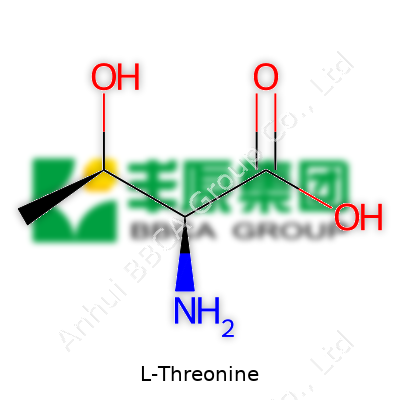
L-Threonine, as an alpha-amino acid with two chiral centers, participates in specific reactions. In our process, we monitor the risk of racemization, especially under harsh purification or drying conditions. Chemical modification is atypical for most applications, but we constantly evaluate the impact of byproducts or transformation under various storage and mixing conditions. Acid hydrolysis, common in other amino acid preparation, often leads to unacceptable degradation for L-Threonine; our method relies on biosynthesis to avoid unwanted byproducts. Research-level modifications, such as protected derivatives for biochemical assays, require separate production lines calibrated for small batches and high purity, which adds to manufacturing complexity.
L-Threonine appears on labels as (2S,3R)-2-Amino-3-hydroxybutanoic acid, L-α-Amino-β-hydroxybutyric acid, or simply as Thr. Trade names pop up occasionally, but most buyers seek out the chemical name. In practice, everyone in the supply chain recognizes L-Threonine and its CAS number more than any brand or trademarked version. Consistency in nomenclature reduces errors, especially when aligning regulatory submissions or export documents across regions with different language preferences.
Working with L-Threonine in bulk does not pose unusual risks, though cleanliness throughout the plant remains essential to guard against cross-contamination. Dust mitigation keeps air levels within regulatory standards, and regular training informs staff about handling procedures, including protective equipment for unloading and mixing. Documentation from occupational health authorities sets out clear exposure limits, but the compound’s low toxicity profile lessens health concerns. Storage in dry, ventilated conditions ensures product remains stable up to expiration, and we rely on periodic QC checks to verify there is no caking, color change, or microbial contamination in long-term lots. Meeting not just local, but international regulatory standards governs every operational choice, with evidence from batch audits and third-party certifications to prove compliance.
Animal nutrition uses L-Threonine extensively to balance dietary requirements in feed. Swine and poultry, both demanding high protein efficiency, benefit when we add L-Threonine to their rations, especially when using soy- or grain-based blends with limiting amino acid profiles. This approach reduces total protein needs, cutting feed costs and lowering nitrogen excretion. Aquafeed formulators have increased interest, given sustainability pressures in fish farming. Some specialized food supplements also include L-Threonine, but feed dominates our shipments by volume. Enzyme, pharmaceutical, and research markets take small quantities with extremely tight purity and documentation requirements. Our technical support teams often work alongside nutritionists and formulators to troubleshoot mixing or application issues, deepening industry knowledge with every partnership.
Continuous process improvement distinguishes manufacturers from traders. In our research spaces, scientists push for higher yield microbial strains using mutagenesis and modern gene editing. Fine-tuning fermentation parameters, such as dissolved oxygen and trace elements, translates quickly to cost savings or easier purification. Our downstream engineers have shortened crystallization times with better seeding techniques, while new membrane technologies filter out impurities earlier in the process. The drive to reduce byproducts and improve environmental metrics keeps our R&D focused, particularly as wastewater treatment and energy use face tighter regulation. Working directly with nutrition researchers, we sometimes produce experimental blends or derivatives aimed at studying animal growth response, immunity, or product stability over time.
Toxicological studies over several decades confirm a strong safety record for L-Threonine in animal and human use at expected dietary inclusion rates. Our safety teams review published data and sponsor studies when new applications raise novel questions. Birds, swine, and fish all tolerate significant inclusion without adverse effects, but as doses move past physiological requirements, growth trials consistently show diminishing returns long before any toxicity. Chronic and sub-chronic toxicity data, as well as genotoxicity studies, all show lack of significant concerns within recommended use levels. Regulatory agencies in most major markets have established maximum levels, which we reference during formulation and customer consultations. Our internal procedures monitor for unintentional contaminants or byproducts that could pose downstream risks, completing the cycle from raw material assessment to finished product testing.
Changing protein markets and consumer expectations have transformed L-Threonine from a specialty compound into a staple of modern nutrition systems. Pressure grows to integrate more sustainable ingredients into both animal and human foods. As precision feeding and micro-encapsulation gain traction, formulations will increasingly require granular, well-characterized L-Threonine that can tolerate heat and mechanical stress in pelleting or extrusion. Our R&D efforts look beyond improving fermentation yields, extending to alternative feedstocks or even upcycling food-processing waste into fermentation substrate. Meanwhile, tightening regulations around nitrogen management and lifecycle carbon accounting will demand ever-more precise traceability. Applications in pet foods and aquaculture seem set to grow, driven by both economics and sustainability priorities. Advances in biotechnology could open doors to customized amino acid blends or entirely new value-added forms of L-Threonine for health and performance benefits in varied species.
Producing amino acids day in, day out has taught us that not all components in animal feed or nutrition have the same impact. L-Threonine stands out for its irreplaceable part in building protein—whether in swine and poultry production or for specialized diets. Walking through production lines, the importance of each batch becomes apparent, especially once you talk to farmers and feed formulators who rely on consistency and purity. Threonine isn’t just another white powder. Its value shows up in the health and productivity of animals that receive right amounts, every day.
The core reason for adding L-Threonine to feed formulations: protein synthesis. Unlike non-essential amino acids, animals cannot produce it themselves. They draw directly from their diet or supplements, and gaps show up fast. Without enough, animals grow slower, convert feed less efficiently, and sometimes lose condition. Feed manufacturers look to minimize waste in expensive ingredients like soybean meal or other protein sources. L-Threonine lets nutritionists optimize rations, balancing amino acid profiles with less crude protein. As a result, farms reduce nitrogen excretion from excess protein, making L-Threonine an environmental solution as much as a nutritional one.
In daily operations, feed producers tell us that L-Threonine gives them flexibility. When raw material markets shift or protein sources rise in cost, they maintain feed quality by adjusting synthetic amino acids rather than overloading expensive protein meals. This brings down feed costs, which ripple all the way back to the cost of pork, chicken, or eggs on store shelves.
Benefits also show up in animal health. Birds and pigs receiving properly balanced threonine grow faster, show more resilience against gut challenges, and demonstrate better immune responses. These are not marketing claims. Nutritionists see direct results in growth trials and commercial farms report lower mortality rates. L-Threonine is especially important for young piglets or chicks under stress, who need precise amino acid ratios to thrive through difficult transitions.
In manufacturing, purity and flowability count. Consistency translates directly into dose accuracy at feed mills. If clumping, impurities, or contamination slip through, negative impacts hit quickly—either economically or in animal health. To keep factories running without hitch, our technicians monitor quality at every stage, from fermentation to final drying and packaging. Our experience says investments in process controls and raw material tracing pay off in fewer batch rejections, less customer downtime, and real trust from nutritionists in the field.
Sustainability pressures all levels of the protein supply chain. Precise L-Threonine inclusion helps cut nitrogen emissions from livestock, which matters more as global regulations evolve. We’re seeing growing questions from integrators and nutritionists about carbon footprint, traceability, and the origin of inputs—including fermentation substrates. Meeting these demands means continuous investment in both process efficiency and open communication with our users. As plant-based diets and new feed laws shift priorities, clean, consistent L-Threonine, supported by full traceability, fits naturally into evolving customer demands.
Making L-threonine is a hands-on process involving precision that leaves little room for shortcuts. People often wonder about the safety of using it in animal feed or supplements. This curiosity doesn’t surprise us, given that anything added to food or feed draws attention. L-threonine is an amino acid that animals and people cannot make by themselves. It plays a supporting role in protein balance, especially in pigs, poultry, and even cattle. That’s why many nutritionists suggest it in feed formulas.
Safety checks start right in the factory. Keeping microbial contamination out and preventing cross-contact with allergens demands everyday vigilance. L-threonine production involves fermentation. Every batch gets tested—no skipped steps. The focus extends to heavy metals, moisture level, and potential by-products. Nothing leaves the site until specs clear internal and external benchmarks. As manufacturers, we feel the weight of these checks because one mistake could shake customer trust and put animals or people at risk.
Decades of research and direct experience point to a strong safety record. Feeding trials with livestock help sharpen our process. Scientists have tried increasing dietary threonine way past recommended inclusion rates. Animals seem unaffected unless intake multiples skyrocket beyond any normal application. Minor digestive upsets pop up if levels go way above requirements, which rarely happens on real farms or in food supplements. L-threonine does not linger in muscle or fat—it metabolizes and leaves the animal just like naturally occurring amino acids.
Regulators around the world have signed off on L-threonine after years of review. Europe, the United States, and most markets put it on the approved list for a wide range of uses. They keep looking for new data. The only issues that come up in special cases involve feed mixing errors or accidental over-supplementation. Manufacturers and feed mills minimize these by following tested formulas and measuring every input down to the gram.
No material leaves our plant without a clear record. Feed manufacturers, nutritionists, and end users ask for traceability and independent certificates. They want to know source, purity, moisture, and the date the lot got packed. We meet these requests, partly because regulators demand it but mostly because the market rewards the honest approach. End users and veterinarians share their experiences with us, flagging anything out of the ordinary. This feedback flows into the ongoing cycle of quality improvement.
Mistakes in mixing or formulating feed sometimes cause side effects, but these rarely trace back to L-threonine itself. Instead, human errors at the feed mill or confusion with dosing create the conditions for unbalanced nutrition. Training and reliable process controls reduce the risk to near zero.
Manufacturers take it seriously by sticking with tight lot controls, transparent documentation, and customer education. Feed users gain from double-checking mixing tables and following the input guidelines. Attention to storage and shelf life also helps. L-threonine’s safety comes from the sum of these habits, not only what the ingredient brings on its own.
Amino acid production companies like ours see few well-substantiated reports of real side effects when best practices guide the process. Safety springs from discipline, experience, and mutual feedback—not just regulatory compliance.
L-Threonine finds its way into animal feed and, increasingly, into dietary supplements. On the production line, this amino acid takes shape through fermentation technology—just as our team has refined for years. We understand the questions that pop up, from "Should I take it with food?" to "How much makes a difference?" The surge in interest brings out many confident statements online, but it helps to hear directly from the source of the molecule.
L-Threonine plays a big role, especially in animal nutrition, as part of protein synthesis. Farmers and feed producers noticed that adding it to feed formulas sharpens feed conversion, allowing them to cut back on rough protein sources like soybean meal. Humans use it for different reasons—joint health, digestion, muscle recovery—but the principle stays the same. Lack of this essential amino acid leads to bottlenecks in protein buildup, making diets less effective. Our technical teams have tracked these improvements in both lab and practical environments, and seen how suboptimal dosing can leave benefits untapped.
Dosage gets tricky fast. In livestock diets, we run calculations based on target species, age, growth phase, and base feed composition. There’s no catchall number. For humans, pharmacy-grade L-Threonine often appears in 100 mg to 500 mg capsules or tablets. Published studies and clinical research most commonly look at doses from 500 mg up to about 2,000 mg per day for adults. In animal applications, the levels run higher, but those calculations center around percent inclusion in feed rather than milligrams per pound.
People sometimes ask if taking more gets quicker results. That isn't how amino acids work. The body uses what it needs; after a certain point, excess gets excreted, putting unnecessary strain on the kidneys in the process. Our application scientists keep a close eye on these thresholds. Overuse doesn’t always trigger obvious trouble, but no one gains from waste or risk. Sticking inside scientifically evaluated dosage ranges makes more sense than following rumor or guesswork.
L-Threonine dissolves in water and rarely causes stomach irritation, but we recommend taking it with or after a meal. Taking amino acids on an empty stomach rarely produces more benefit and can cause more rapid absorption than the body needs at one time. We see this in both animal and human studies. Blending the supplement into food, or taking with water after eating, supports steadier absorption.
In industrial applications, feed manufacturers and formulators use powder or granulated forms because they mix smoothly with grains and premixes. End users—whether pet owners or consumers—should follow the label instructions or, better yet, confirm advice with a professional who understands their dietary needs.
As direct producers, we spend just as much effort verifying quality and purity as we do manufacturing the molecule itself. Contamination with unwanted amino acids or foreign compounds cuts value and, in some cases, may cause harm. Reputable supply chains include batch testing and full traceability. Farmers and supplement users alike feel the impact of shortcuts. That’s why we stand behind thorough documentation for each shipment that leaves our plant.
Supplements never replace whole foods or a balanced diet. L-Threonine helps in clear and specific cases: filling a gap, supporting specific recovery or health goals, or addressing a documented deficiency. Anything beyond that strays into speculation. We encourage open conversations between users and knowledgeable professionals, and avoid miracle claims that ignore human physiology.
Years of hands-on production and research have made it clear: L-threonine plays an important role in both human and animal nutrition. From our facility floors, we see this amino acid most often incorporated in feeds and dietary blends designed to support protein metabolism. There’s plenty of curiosity about combining threonine with other nutrients or medicines. As producers, we encourage people to consider what we have observed and learned directly from partners and end users.
In feeds and supplement blends, L-threonine usually appears alongside lysine, methionine, and tryptophan—three other essential amino acids. Our technicians have mixed these for years without reporting any significant technical difficulties or antagonistic effects. Many livestock operations, as well as nutrition scientists, have confirmed that combinations improve growth rates and metabolic balance, provided the amino acids are proportionate. Even in human formulations, threonine commonly joins multivitamin blends, protein powders, and various functional mixes. Our interaction with dietitians and product formulators shows that combining L-threonine with vitamins and minerals in the right amounts creates no issues for the average, healthy consumer.
Pharmaceutical interactions require a different approach. L-threonine itself is not a drug, but it participates in crucial metabolic pathways, including the synthesis of glycine and serine. Any medication that alters protein synthesis, amino acid metabolism, or kidney function could theoretically influence threonine requirements or its material balance in the bloodstream. We routinely remind customers and researchers to involve healthcare professionals when pairing L-threonine with prescription drugs, especially if the user manages chronic conditions related to liver function, renal health, or genetic disorders. Our manufacturing team does not take the place of a clinician’s direct advice. We supply a pure, well-characterized ingredient; beyond that, medical specialists need to assess the risks of interaction on an individual basis, since some medicines alter amino acid dynamics in ways that a layperson or non-specialist may not expect.
Our observations show that, in most cases, those running into trouble with threonine and other supplements mix and match products that vary in quality and source. We invest continually in refining purification, monitoring foreign residues, and ensuring batch-to-batch consistency. This gives formulators and clinicians a stable base for decision-making. Responsible use also means paying attention to realistic daily intakes instead of simply stacking supplements and hoping for better results. Too much threonine—rare though it is—can disrupt the body’s natural amino acid ratio. This matters more when someone takes medication that relies on predictable protein metabolism.
Years of supplying L-threonine in bulk for nutrition companies, clinics, and feed mills show that most users do well when they establish open communication with their healthcare provider and carefully read supplement composition. In our world, safe usage grows from a clear line of sight on origin, purity, and purpose. Anyone considering combinations should keep this in mind, listen to professional advice, and factor in individual health status when putting together supplement regimens involving L-threonine.
L-Threonine brings clear nutritional value. We see firsthand every day how it helps balance amino acid profiles for feed and food producers across the globe. Still, not every user stands to benefit, and some face genuine risk. Over the years, our technical teams, manufacturing partners, and feed mill customers have flagged several clear groups who should avoid dosing L-Threonine, even though its benefits get plenty of buzz in the industry.
The liver and kidneys process amino acids before distributing their building blocks through the body. Individuals with liver or renal disorders face higher chances of complications from an influx of supplemental L-Threonine. We’ve worked with several animal nutrition researchers who monitor these cases closely, and in our own client base, it’s become routine advice: do not introduce synthetic amino acids, L-Threonine included, to those struggling with underlying liver or kidney health. Their bodies just cannot break it down the way intended, which drives up the risk of toxicity, buildup, or further deterioration in organ function.
Though we manufacture L-Threonine to the highest purity, reactions in sensitive populations remind us that no process removes every possibility of side effects. True threonine allergies may be rare, but some individuals respond poorly even to trace fermentation byproducts or residual compounds from the manufacturing process. Years ago, one of our quality assurance leads fielded a rash of calls about an unrelated food allergy, and the experience still shapes our production — we keep allergen controls at the highest setting, and customers are encouraged to review ingredients and batch specifics if they have any questions about sensitivities. To this day, we urge anyone with a known amino acid hypersensitivity to avoid L-Threonine entirely, regardless of the label claim for purity or “natural source.”
Children’s amino acid requirements differ from adult needs. Premature, neonatal, or pediatric populations have strict dietary controls for a reason. Our plant does not supply L-Threonine intended for direct pediatric supplementation. Pediatric physicians insist on close balance of amino acids to avoid long-term developmental impacts, and no over-the-counter or livestock-grade supplement suits their needs. Pregnant or breastfeeding people face similar safeguards. Traceable purity, batch integrity, and full data transparency matter most for these groups, and such users require clinical-grade materials, not bulk food or feedstock. We’ve seen complications arise even from seemingly minor imbalances in amino acid formulations, underlining the need for medical direction.
Countless hobbyists call us about buying L-Threonine for home wellness mixes. We discourage anyone from adding L-Threonine, or any synthetic amino acid, to their regimen without dietitian input. Minor imbalances don’t always show right away, but our partners in animal nutrition sciences have documented the cost of even slight oversupplementation — metabolic stress, wasted nutrients, and, in rare cases, more severe problems. Nutrition works best with balance, careful monitoring, and professional guidance. Whether for livestock or people, responsible manufacturers recommend consultation with a dietitian or a veterinarian first, never self-directed use.
Years at the production level have taught us that L-Threonine fits only where it belongs, and not for everyone. Exclusion is not about shutting doors, but about respecting human physiology and the true science behind the ingredient. We commit to sharing our knowledge openly, always pointing clients and consumers to proper guidance and safe, proven applications.